Carbon Compounds
Organic and inorganic compounds are two important types of compounds. Carbon is the essential element in organic compounds. Compounds having carbon as a constituent element are generally called carbon compounds.
- Bonds in carbon compounds
- Carbon: a versatile element
- Hydrocarbons and structural isomerism
- Functional groups and homologous series
- IUPAC nomenclature
- Chemical properties of carbon compounds
- Ethanol and ethanoic acid
- Macromolecules and polymers
Important inorganic carbon compounds include carbon dioxide, carbon monoxide, carbide salts, carbonate salts and bicarbonate salts.
Bonds in Carbon Compounds
Most carbon compounds have comparatively low melting and boiling points. Their melting and boiling points are generally below 300°C.
- Intermolecular attractive forces are weak.
- Most carbon compounds are poor conductors of electricity.
- Most carbon compounds do not contain ionic bonds.
- Their chemical bonds generally do not produce ions.
- Carbon compounds mainly contain covalent bonds.
| Compound | Formula | Melting point | Boiling point |
|---|---|---|---|
| Methane | CH₄ | −183°C | −162°C |
| Ethanol | C₂H₅OH | −117°C | 78°C |
| Chloroform | CHCl₃ | −64°C | 61°C |
| Acetic acid | CH₃COOH | 17°C | 118°C |
Carbon and Covalent Bond
Atomic number of carbon = 6. Its electronic configuration is 2,4 and its valency is 4.
Carbon cannot easily lose four electrons to form C⁴⁺ and cannot easily gain four electrons to form C⁴⁻. It therefore attains stability mainly by sharing electrons with other atoms.
The chemical bond formed by sharing of two valence electrons between two atoms is called a covalent bond.
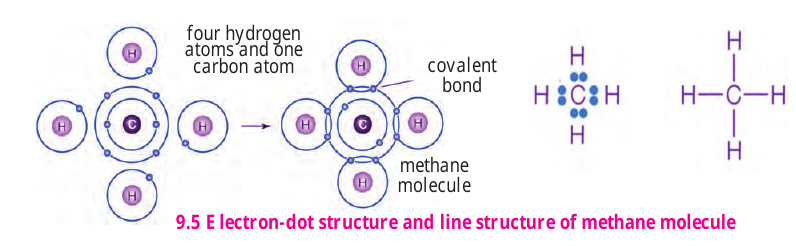
Single, Double and Triple Bonds
Two carbon atoms can be bonded together by one, two or three covalent bonds. These are called single bond, double bond and triple bond respectively.
- One shared pair → single bond
- Two shared pairs → double bond
- Three shared pairs → triple bond
Examples:
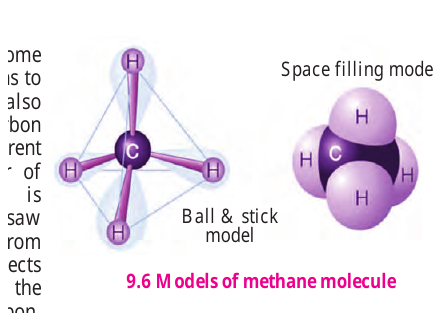
Carbon: A Versatile Element
Carbon forms an extremely large number of compounds because of the special nature of its covalent bonds.
Catenation
The ability of carbon atoms to form strong covalent bonds with other carbon atoms is called catenation power.
- Carbon forms long chains.
- Chains may be straight or branched.
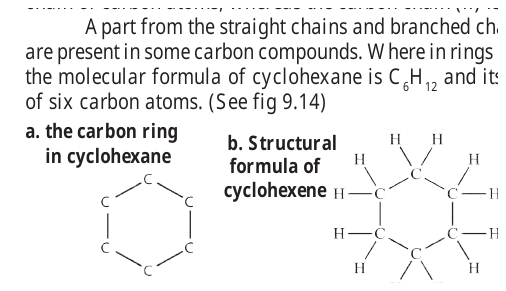
- Carbon atoms may form closed ring structures.
- Carbon–carbon bonds are strong and stable.
Tetravalency
Carbon being tetravalent can form bonds with four other atoms, carbon or any other element. This results in a very large number of carbon compounds.
Hydrocarbons
Hydrocarbons are compounds containing carbon and hydrogen as the only two elements.
Saturated hydrocarbons
Compounds in which carbon atoms are joined only by single bonds are called saturated compounds. Saturated hydrocarbons are also called alkanes.
Unsaturated hydrocarbons
Carbon compounds having a double bond or triple bond between two carbon atoms are called unsaturated compounds.
- Double bond → alkene
- Triple bond → alkyne
- Unsaturated hydrocarbons are generally more reactive than saturated hydrocarbons.
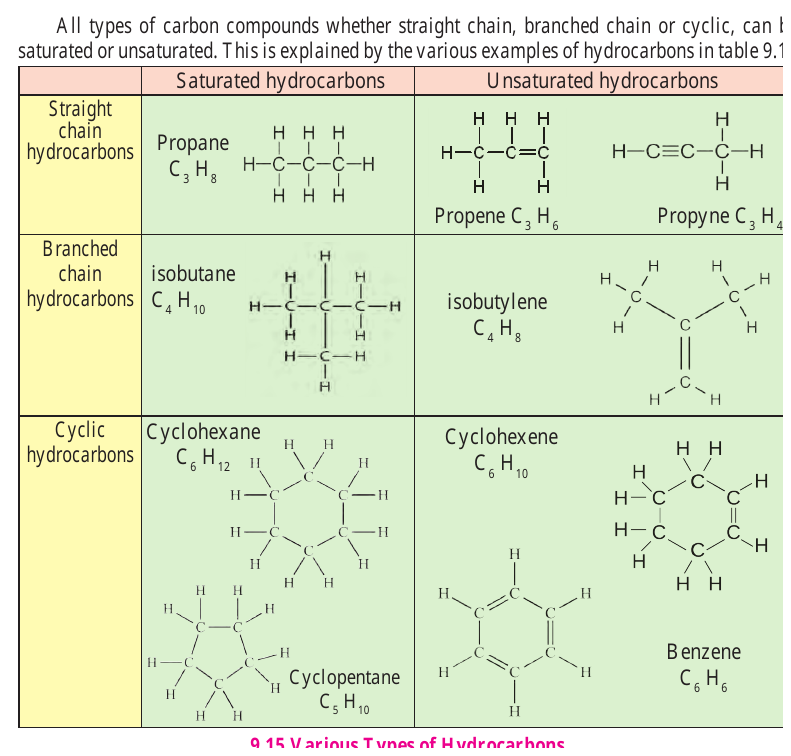
Straight, Branched and Ring Structures
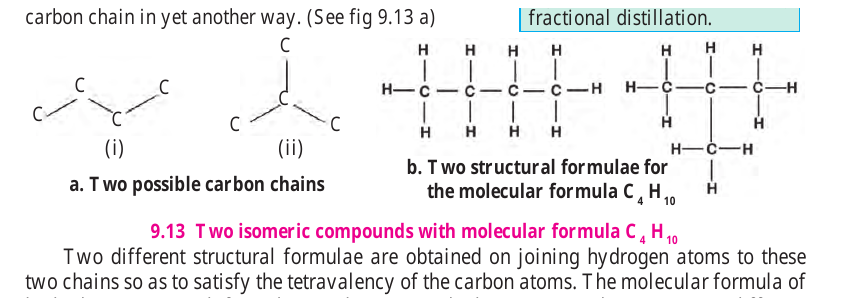
The carbon skeleton determines the shape of a carbon compound.
- A straight chain is formed when carbon atoms are joined next to one another.
- A branched chain contains a branch in the carbon skeleton.
- A closed chain forms a ring structure.
Structural isomerism
The phenomenon in which compounds having different structural formulae have the same molecular formula is called structural isomerism.
For C₄H₁₀, two different structural formulae are possible: one straight-chain and one branched-chain compound.
Functional Groups
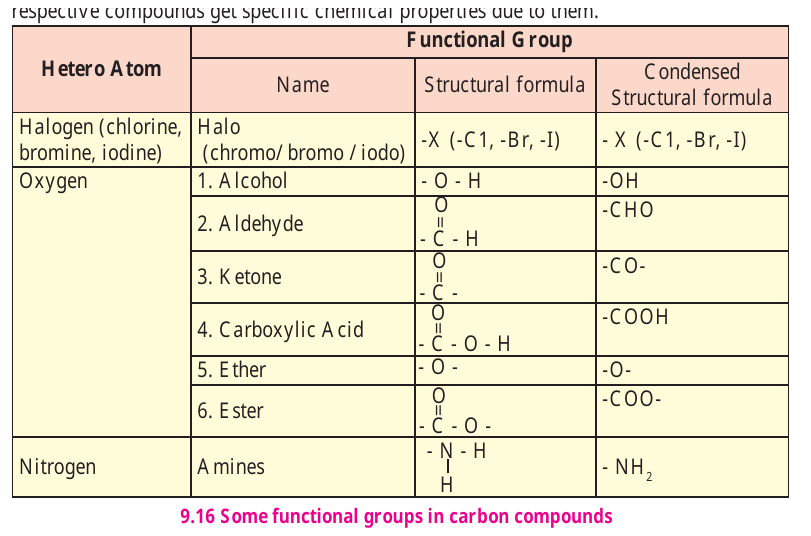
Atoms such as halogens, oxygen, nitrogen and sulphur can substitute one or more hydrogen atoms in a hydrocarbon chain. The atom that substitutes hydrogen is called a hetero atom.
The hetero atom or group of atoms containing hetero atoms that gives specific chemical properties to a carbon compound is called a functional group.
Homologous Series
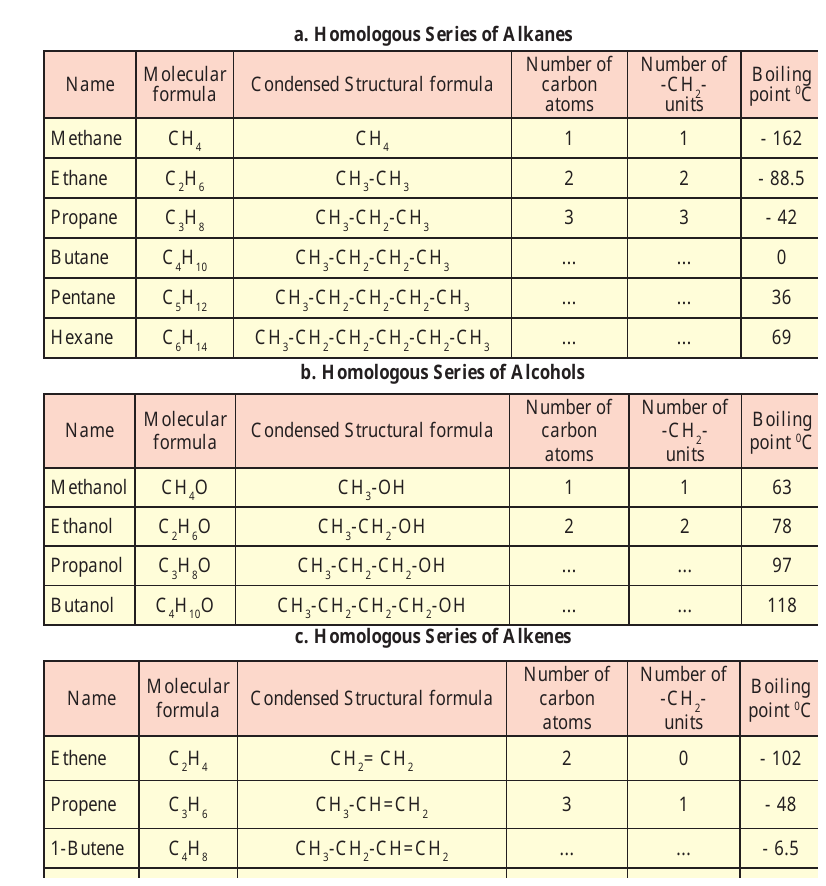
The series of compounds formed by joining the same functional group in place of a particular hydrogen atom on carbon chains having sequentially increasing length is called a homologous series.
- Successive members differ by one –CH₂– unit.
- Molecular mass of successive members differs by 14 u.
- Members have the same functional group.
- Chemical properties are similar.
- The carbon chain length increases successively.
General Formulae
The important homologous series have the following general formulae.
| Series | General formula | Example |
|---|---|---|
| Alkanes | CₙH₂ₙ₊₂ | CH₄, C₂H₆ |
| Alkenes | CₙH₂ₙ | C₂H₄, C₃H₆ |
| Alkynes | CₙH₂ₙ₋₂ | C₂H₂, C₃H₄ |
Remember: successive members of a homologous series differ by –CH₂– and their molecular masses differ by 14 u.
IUPAC Nomenclature – Step 1
IUPAC stands for International Union for Pure and Applied Chemistry. It provides a systematic method for giving unique names to carbon compounds.
Step 1
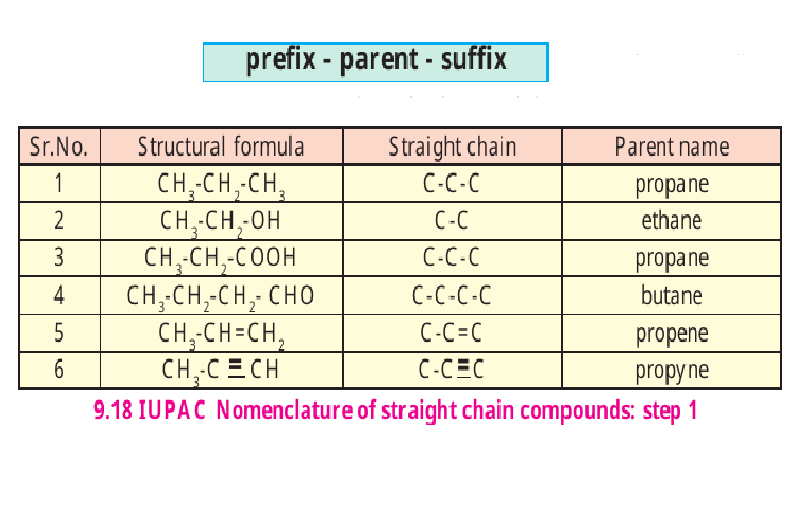
- Draw the structural formula and count the carbon atoms in the longest straight chain.
- Select the corresponding parent alkane.
- For a double bond, change the ending “ane” to “ene”.
- For a triple bond, change the ending “ane” to “yne”.
IUPAC Nomenclature – Steps 2 and 3
Step 2
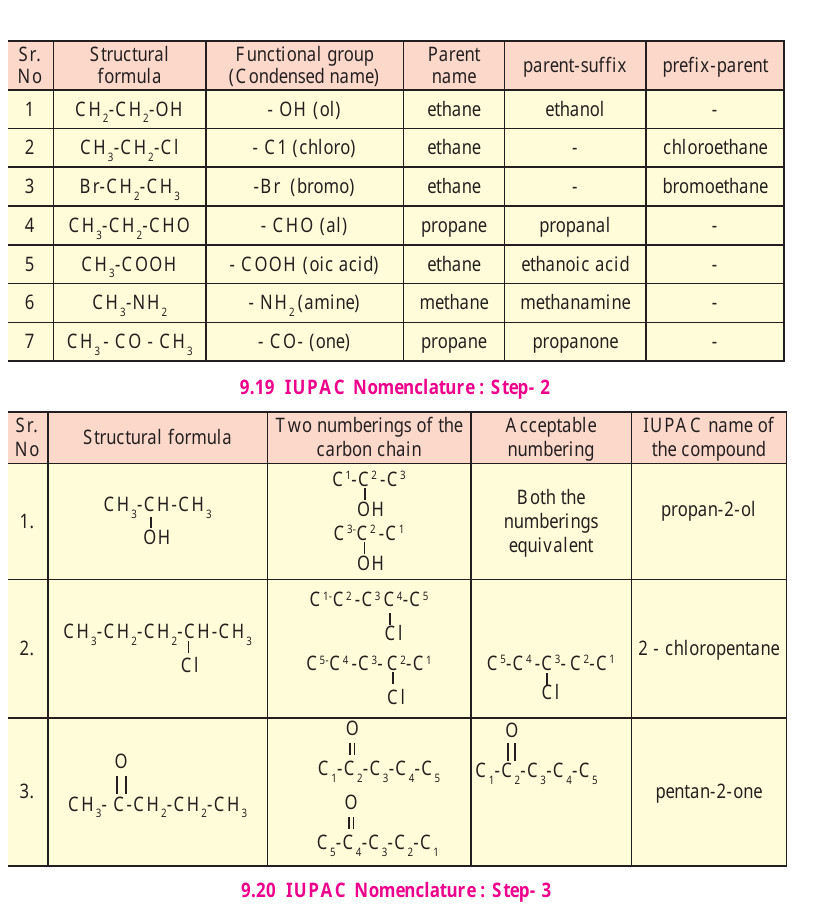
If a functional group is present, replace the last letter “e” of the parent name by the condensed name of the functional group as the suffix. Halogens are written as prefixes.
Step 3
- Number the carbon chain from one end to the other.
- Give number 1 to carbon in –CHO or –COOH when present.
- Otherwise, number the chain so that the carbon carrying the functional group gets the smaller number.
- Separate a number and a letter by a small horizontal line.
Chemical Properties – Combustion
Carbon compounds burn in the presence of oxygen and produce heat and light. Carbon dioxide and water are common products.
Saturated and unsaturated compounds
- Saturated compounds generally burn with a clean blue flame.
- Unsaturated compounds generally burn with a yellow flame and release black smoke or soot.
- Hot carbon particles emit yellow light.
- If oxygen supply is limited, even saturated compounds may give a yellow flame.
Oxidation
During combustion, carbon compounds combine with oxygen and are completely oxidised. Substances that provide oxygen to other substances are called oxidants or oxidizing agents.
- Potassium permanganate is a common oxidizing agent.
- Potassium dichromate is another common oxidizing agent.
Oxidation of ethanol
Ethanol is oxidised by alkaline potassium permanganate to form ethanoic acid. The pink colour of potassium permanganate disappears while the oxidant is being consumed.
Addition Reaction
The reaction in which atoms or groups are added to an unsaturated compound is called an addition reaction.
Unsaturated compounds can react with hydrogen in the presence of platinum or nickel catalyst to form saturated compounds.
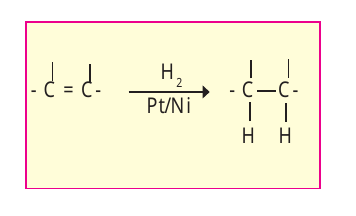
This reaction is used for hydrogenation of vegetable oils. Hydrogenation converts unsaturated chains into saturated chains and vanaspati ghee is formed.
Substitution Reaction
The reaction in which one type of atom or group in a reactant is replaced by another atom or group of atoms is called a substitution reaction.
Saturated hydrocarbons react with chlorine in the presence of sunlight. Chlorine atoms replace hydrogen atoms one by one.
Ethanol
Ethanol has molecular formula C₂H₅OH or CH₃CH₂OH.
- It is a colourless liquid at room temperature.
- Boiling point is 78°C.
- It is also called alcohol or spirit.
- It is soluble in water in all proportions.
- Its aqueous solution is neutral to litmus.
- It is a good solvent and is used in tincture iodine, cough mixtures, tonics and medicines.
Methanol
Methanol is poisonous. Small quantities can affect vision and may be lethal. Ethanol mixed with methanol is called denatured spirit; blue dye is added for recognition.
Ethanol – Reaction with Sodium and Dehydration
Reaction with sodium
Products: sodium ethoxide and hydrogen gas.
Dehydration of ethanol
When ethanol is heated at 170°C with excess concentrated sulphuric acid, one molecule of water is removed and ethene is formed.
Concentrated sulphuric acid acts as a dehydrating agent.
Ethanoic Acid
Ethanoic acid has formula CH₃COOH and common name acetic acid.
- It is a colourless liquid.
- Boiling point = 118°C.
- Its aqueous solution is acidic.
- It turns blue litmus red.
- Vinegar contains 5–8% aqueous acetic acid.
- Pure ethanoic acid freezes around 17°C and is called glacial acetic acid.
Reaction with sodium hydroxide
Ethanoic Acid – Carbonate and Bicarbonate
With sodium carbonate
Effervescence is produced because carbon dioxide gas is released. Carbon dioxide turns lime water milky.
With sodium bicarbonate
Esterification
Esters are formed by the reaction between a carboxylic acid and an alcohol.
Ethanoic acid reacts with ethanol in presence of an acid catalyst and ethyl ethanoate is formed.
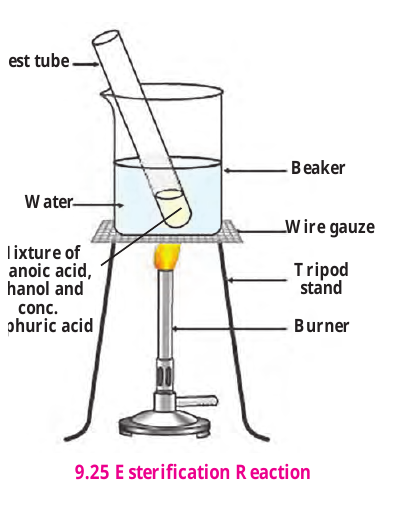
Esters generally have a sweet odour and are used in fragrances and flavouring agents.
Saponification
The reaction of an ester with sodium hydroxide to form sodium carboxylate and alcohol is called saponification reaction.
General reaction:
When fat is heated with sodium hydroxide, soap and glycerin are formed.
Macromolecules
Giant carbon molecules formed from hundreds or thousands of atoms are called macromolecules.
Natural macromolecules
- Polysaccharides – starch and cellulose
- Proteins – form a large part of animal bodies and help in physiological processes
- Nucleic acids – control heredity at the molecular level
- Natural rubber
Polysaccharides provide food and materials such as fibres and paper. Proteins and nucleic acids perform important functions in living organisms.
Polymers and Polymerization
A macromolecule formed by regular repetition of a small unit is called a polymer.
The small unit that repeats regularly to form a polymer is called a monomer.
The reaction by which monomer molecules are converted into a polymer is called polymerization.
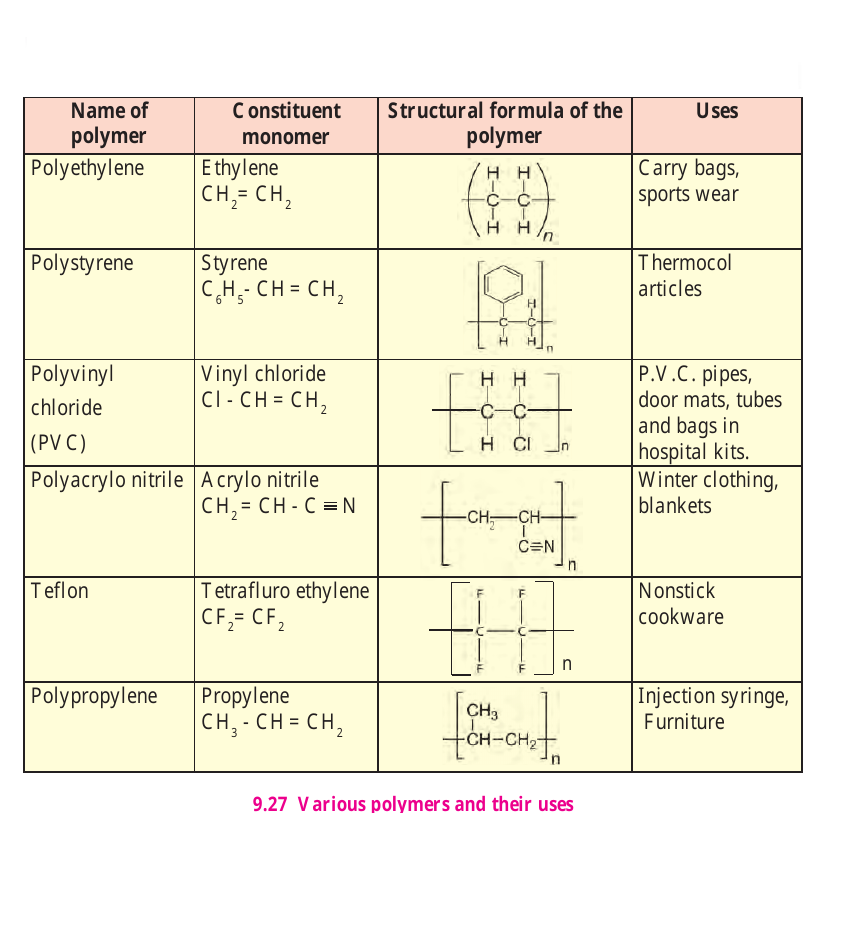
Examples of Synthetic Polymers
| Polymer | Monomer | Use |
|---|---|---|
| Polyethylene | Ethylene | Carry bags, sports wear |
| Polystyrene | Styrene | Thermocol articles |
| PVC | Vinyl chloride | Pipes, mats, tubes, hospital-kit bags |
| Polyacrylonitrile | Acrylonitrile | Winter clothing, blankets |
| Teflon | Tetrafluoroethylene | Nonstick cookware |
| Polypropylene | Propylene | Injection syringes, furniture |
Homopolymer and copolymer
- Homopolymer: formed by repetition of a single type of monomer.
- Copolymer: formed from two or more different monomers.
- Polymer structures may be linear, branched or cross-linked.
Board Exam Quick Revision – Definitions
- Covalent bond – chemical bond formed by sharing of two valence electrons between two atoms.
- Catenation – ability of carbon atoms to form strong covalent bonds with other carbon atoms.
- Hydrocarbon – compound containing carbon and hydrogen as the only two elements.
- Saturated compound – carbon compound in which carbon atoms are joined by single bonds.
- Unsaturated compound – carbon compound containing double or triple bonds.
- Functional group – atom or group of atoms containing hetero atoms that gives specific chemical properties.
- Homologous series – series having the same functional group and sequentially increasing carbon-chain length.
- Addition reaction – reaction in which atoms or groups are added to an unsaturated compound.
- Substitution reaction – reaction in which one atom or group is replaced by another.
Board Exam Quick Revision – Alcohol, Acid and Polymer
- Esterification – formation of an ester by reaction between a carboxylic acid and an alcohol.
- Saponification – reaction of an ester with sodium hydroxide to form sodium carboxylate and alcohol.
- Polymer – macromolecule formed by regular repetition of a small unit.
- Monomer – small unit that repeats regularly to form a polymer.
- Polymerization – reaction by which monomers are converted into a polymer.
For a 2–4 mark answer, write the definition first, then the required points and the correct textbook reaction or example.
Most Important Reactions
Write balanced equations and mention the condition such as sunlight, catalyst or concentrated H₂SO₄ wherever required.