Metallurgy
Chapter 8 deals with the physical and chemical properties of metals and nonmetals, ionic compounds and the extraction and purification of metals.
- Physical properties of metals and nonmetals
- Chemical properties and reactivity series
- Ionic compounds
- Metallurgy, ores, minerals and gangue
- Concentration and extraction of metals
- Refining, corrosion, prevention and alloys
For chemical reactions, write the balanced equation clearly and mention the important condition or product wherever required.
Physical Properties of Metals
- Metals mainly exist in solid state.
- Mercury and gallium exist in liquid state at room temperature.
- Metals possess metallic lustre.
- Metals show ductility and malleability.
- Metals are generally good conductors of heat and electricity.
- Metals are generally hard, but lithium, sodium and potassium are soft.
- Metals generally have high melting and boiling points.
- Tungsten has a very high melting point of about 3422°C.
- Some metals produce sound when struck. Such metals are called sonorous metals.
Ductility = ability to be drawn into wires. Malleability = ability to be beaten into thin sheets.
Physical Properties of Nonmetals
- Some nonmetals are solids and some are gases.
- Bromine is a liquid nonmetal at room temperature.
- Nonmetals generally do not possess lustre.
- Iodine is an exception because its crystals are shiny.
- Nonmetals are generally not hard.
- Diamond is an exception and is the hardest natural substance.
- Nonmetals generally have low melting and boiling points.
- Nonmetals are generally poor conductors of heat and electricity.
- Graphite is an exception because it conducts electricity.
Bromine → liquid nonmetal. Iodine → lustrous nonmetal. Diamond → hardest natural substance. Graphite → conducts electricity.
Metals + Oxygen
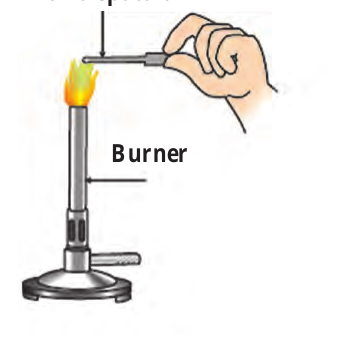
Metals combine with oxygen on heating in air and form metal oxides.
Sodium
Sodium combines with oxygen even at room temperature and forms sodium oxide.
4Na + O2 → 2Na2O
Sodium readily catches fire in air. Therefore, it is kept in kerosene.
Na2O + H2O → 2NaOH
Magnesium
2Mg + O2 → 2MgO
MgO + H2O → Mg(OH)2
Metals + Water
- Sodium and potassium react rapidly and vigorously with water and liberate hydrogen.
2Na + 2H2O → 2NaOH + H2 + heat
2K + 2H2O → 2KOH + H2 + heat
Calcium reacts slowly and less vigorously with water. Hydrogen bubbles collect on its surface, so calcium floats.
2Ca + 2H2O → 2Ca(OH)2 + H2
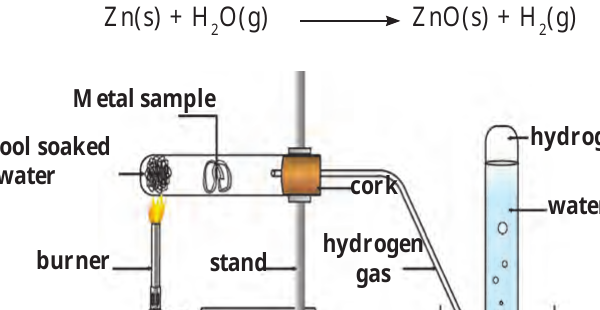
Aluminium, iron and zinc react with steam and form oxides.
2Al + 3H2O(g) → Al2O3 + 3H2
3Fe + 4H2O(g) → Fe3O4 + 4H2
Zn + H2O(g) → ZnO + H2
Metals + Acids and Nitric Acid
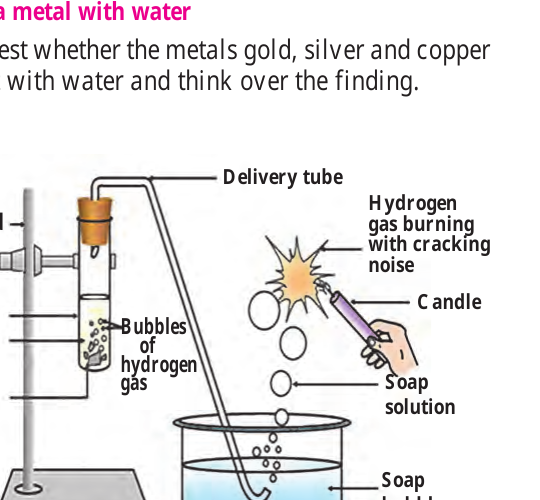
Aluminium, magnesium, iron and zinc react with dilute sulphuric or hydrochloric acid to form salts and liberate hydrogen gas.
Mg + 2HCl → MgCl2 + H2
2Al + 6HCl → 2AlCl3 + 3H2
Fe + 2HCl → FeCl2 + H2
Zn + 2HCl → ZnCl2 + H2
Mg > Al > Zn > Fe
Nitric acid
Reaction of metals with nitric acid forms nitrate salts and nitrogen oxides according to the concentration of nitric acid.
Cu + 4HNO3(conc.) → Cu(NO3)2 + 2NO2 + 2H2O
3Cu + 8HNO3(dil.) → 3Cu(NO3)2 + 2NO + 4H2O
Aqua regia is a highly corrosive and fuming liquid prepared freshly by mixing concentrated hydrochloric acid and concentrated nitric acid in the ratio 3:1. It can dissolve noble metals such as gold and platinum.
Metals + Salt Solutions
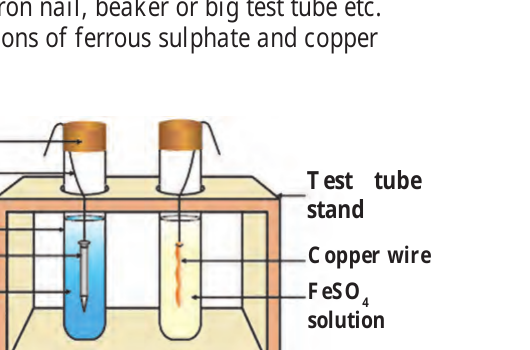
If a metal A displaces metal B from the solution of its salt, metal A is more reactive than metal B.
Metal A + Salt solution of metal B → Salt solution of metal A + Metal B
In the textbook activity, iron displaces copper from copper sulphate. Therefore, iron is more reactive than copper.
A more reactive metal displaces a less reactive metal from its salt solution.
Reactivity series
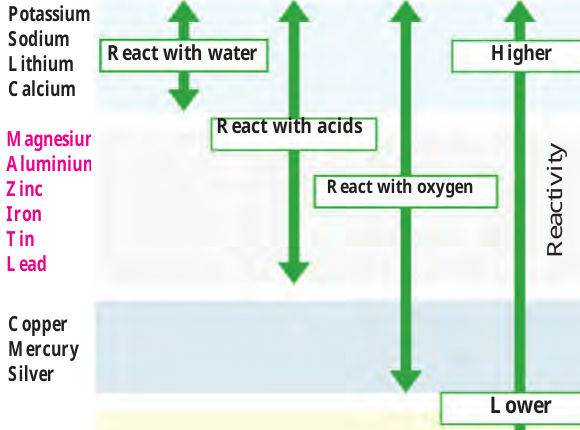
K > Na > Li > Ca > Mg > Al > Zn > Fe > Sn > Pb > Cu > Hg > Ag > Au
Metals + Nonmetals
Metals lose electrons and form positive ions called cations.
Nonmetals gain electrons and form negative ions called anions.
The driving force behind many reactions is the tendency to attain the electronic configuration of the nearest noble gas.
Example: Sodium chloride
Sodium gives one electron and chlorine takes one electron.
2Na + Cl2 → 2NaCl
Similarly, magnesium forms MgCl2 and potassium forms KCl.
Chemical properties of nonmetals
Generally, nonmetals combine with oxygen to form acidic oxides. In some cases neutral oxides are formed.
C + O2 → CO2 (acidic)
2C + O2 → 2CO (neutral)
S + O2 → SO2 (acidic)
Generally, nonmetals do not react with water or dilute acids; halogens are exceptions.
Ionic Compounds
The compounds formed from cations and anions are called ionic compounds.
The electrostatic force of attraction between oppositely charged ions is called an ionic bond.
The positive and negative charges balance each other, so an ionic compound is electrically neutral.
General properties
- Ionic compounds are crystalline in nature.
- They are generally hard and brittle.
- They have strong electrostatic attraction between ions.
- They generally have high melting and boiling points.
- The size and charge of ions affect crystal structure.
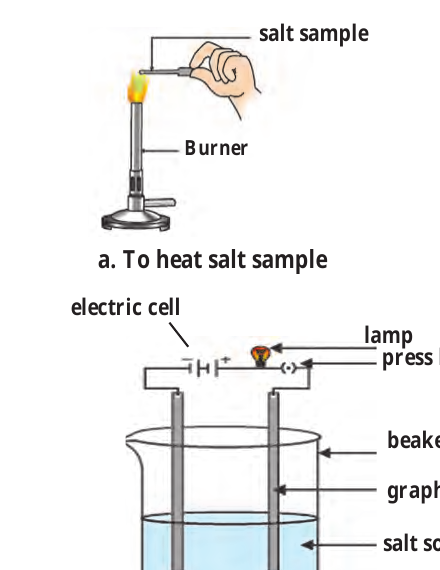
In the solid state ions cannot move freely. In the molten state and in aqueous solution, ions become mobile and conduct electricity.
More Properties of Ionic Compounds
- Solid and hard: strong attraction between oppositely charged ions.
- Brittle: ionic compounds can break into pieces when pressure is applied.
- High melting and boiling points: large energy is needed to overcome strong attraction.
- Water soluble: water molecules interact with ions and help form aqueous solutions.
- Electrical conductivity: solid ionic compounds do not conduct electricity because ions cannot move. Molten and aqueous ionic compounds conduct electricity because ions are mobile.
Ionic compounds are called electrolytes when they conduct electricity in fused or dissolved state.
Metallurgy, Minerals, Ores and Gangue
The science and technology regarding the extraction of metals from ores and their purification for use is called metallurgy.
The compounds of metals that occur in nature along with impurities are called minerals.
The minerals from which the metal can be separated economically are called ores.
Impurities such as soil, sand and rocky substances present along with metal compounds in ores are called gangue.
Occurrence of metals
- Most reactive metals occur in combined state as oxides, carbonates, sulphides or nitrates.
- Very unreactive metals such as silver, gold and platinum generally occur in free state.
Concentration of Ores
The process of separating gangue from ores is called concentration of ores.
The concentration method depends on the physical properties of the ore and gangue, reactivity of the metal, available purification facilities and environmental factors.
Separation based on gravitation
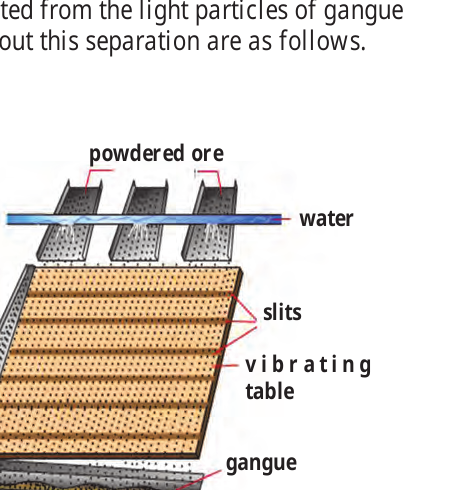
Heavy ore particles can be separated from lighter gangue particles by gravitational methods.
Wilfley table method
Powdered ore is placed on a continuously vibrating inclined table. Water is released over it. Lighter gangue is carried away by water while heavier ore particles are retained by the wooden riffles.
Hydraulic and Magnetic Separation
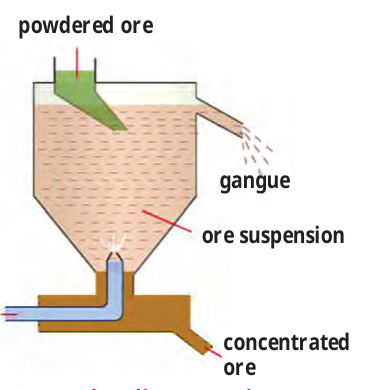
Hydraulic separation
Finely ground ore is released into a tank. A forceful jet of water is introduced from the lower side. Lighter gangue flows away with water while heavier ore particles are collected at the bottom.
Magnetic separation
An electromagnetic machine is used. Magnetic particles are attracted to the magnetic roller, while nonmagnetic particles continue along the conveyor belt and are collected separately.
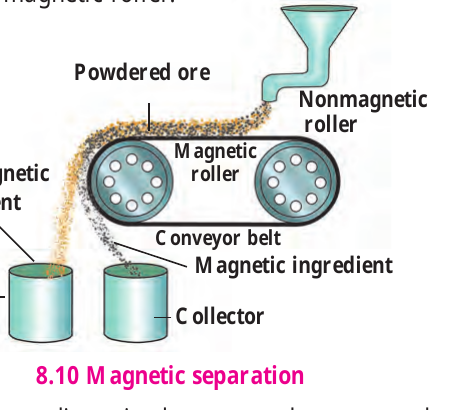
Example: Cassiterite contains nonmagnetic SnO2 and magnetic FeWO4; these can be separated by electromagnetic separation.
Froth Floatation and Leaching
Froth floatation method
This method is based on hydrophilic and hydrophobic properties.
- Sulphide ore particles are wetted mainly by oil.
- Gangue particles are wetted by water.
- Pine oil or eucalyptus oil is added.
- Pressurised air is passed through the mixture.
- Froth is formed and sulphide ore particles float with it.
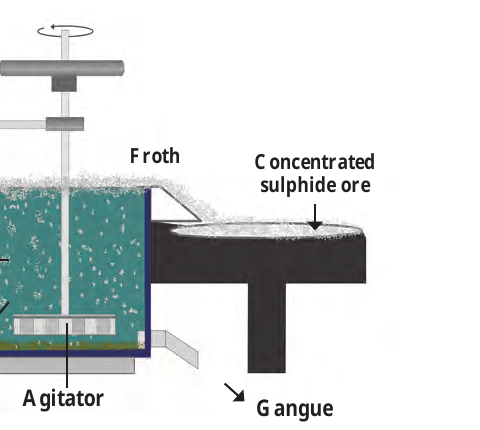
Examples: zinc blende (ZnS) and copper pyrite (CuFeS2).
Leaching
In leaching, the ore is soaked in a suitable solution. The desired component dissolves while gangue does not dissolve and can be separated.
Leaching is used in the extraction of aluminium, gold and silver. Bauxite is soaked in aqueous NaOH or aqueous Na2CO3.
Extraction of Highly Reactive Metals
Highly reactive metals occur at the top of the reactivity series. Examples are potassium, sodium, aluminium, calcium and magnesium.
These metals have a large tendency to form cations by losing electrons. Their extraction is carried out by electrolytic reduction.
Example: Sodium from molten sodium chloride
Metal is deposited at the cathode and chlorine gas is liberated at the anode.
Na+ + e− → Na (Reduction)
2Cl− → Cl2 + 2e− (Oxidation)
Extraction of Aluminium – Concentration
Aluminium is a reactive metal and occurs mainly as bauxite.
Formula: Al2O3·nH2O. It contains about 30%–70% Al2O3. Main impurities include SiO2, Fe2O3 and TiO2.
Bayer's process
Bauxite is ground and leached with concentrated NaOH at about 140–150°C under high pressure. Aluminium oxide reacts with NaOH and forms soluble sodium aluminate.
Al2O3 + 2NaOH → 2NaAlO2 + 3H2O
Iron oxide does not dissolve and is separated by filtration. Silica dissolves to form sodium silicate.
Hall's process
Powdered bauxite is heated with aqueous sodium carbonate to form soluble sodium aluminate. Insoluble impurities are filtered out and carbon dioxide is passed through the filtrate to precipitate aluminium hydroxide.
Al2O3·2H2O + Na2CO3 → 2NaAlO2 + CO2 + 2H2O
2NaAlO2 + 3H2O + CO2 → 2Al(OH)3 + Na2CO3
Alumina and Electrolytic Reduction
The precipitated aluminium hydroxide is filtered, washed, dried and calcined at about 1000°C to obtain alumina.
2Al(OH)3 → Al2O3 + 3H2O
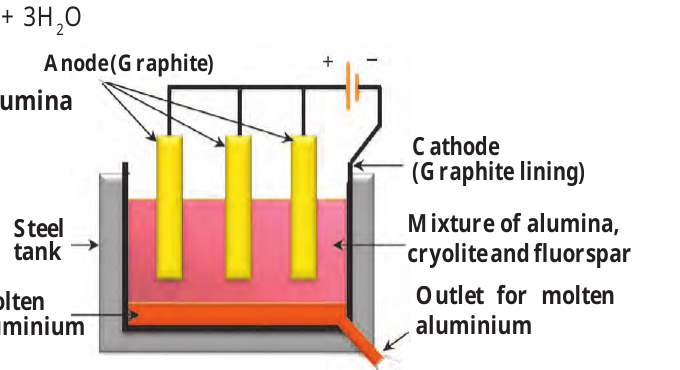
- Electrolysis of molten alumina is carried out in a steel tank.
- The inner graphite lining acts as cathode.
- Graphite rods act as anodes.
- Cryolite (Na3AlF6) and fluorspar (CaF2) lower the melting point to about 1000°C.
- Aluminium is deposited at the cathode.
- Oxygen is liberated at the anode.
2O2− → O2 + 4e− (Oxidation)
Al3+ + 3e− → Al (Reduction)
Extraction of Moderately Reactive Metals
Iron, zinc, lead and copper are moderately reactive metals. They generally occur as sulphide or carbonate ores.
Roasting
Strong heating of sulphide ores in air to transform them into oxides is called roasting.
2ZnS + 3O2 → 2ZnO + 2SO2
Calcination
Strong heating of carbonate ores in a limited supply of air to transform them into oxides is called calcination.
ZnCO3 → ZnO + CO2
Sulphide ore + air + strong heating → Roasting. Carbonate ore + limited air + strong heating → Calcination.
Reduction and Thermit Reaction
Reduction of zinc oxide
Zinc oxide is reduced using carbon.
ZnO + C → Zn + CO
Apart from carbon, reactive metals such as sodium, calcium and aluminium can act as reducing agents.
Thermit reaction
Ferric oxide reacts with aluminium to form iron and aluminium oxide with a large amount of heat.
Fe2O3 + 2Al → 2Fe + Al2O3 + heat
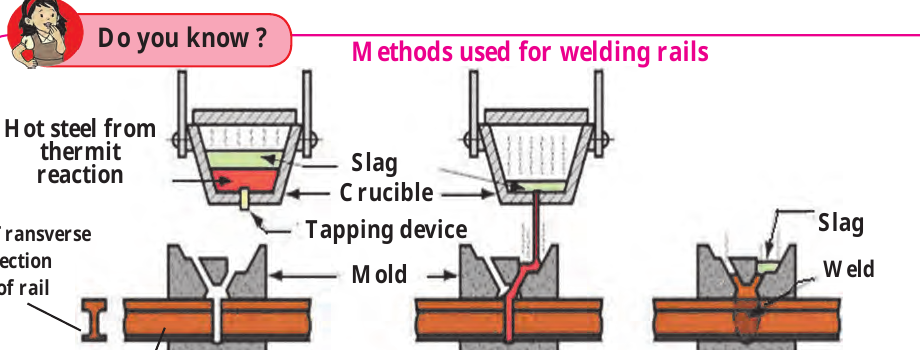
Another example:
3MnO2 + 4Al → 3Mn + 2Al2O3 + heat
Less Reactive Metals and Refining
Less reactive metals
Metals at the bottom of the reactivity series are less reactive. Gold, silver and platinum generally occur in free state.
Extraction of copper
Copper is mainly found as Cu2S and is obtained by heating in air.
2Cu2S + 3O2 → 2Cu2O + 2SO2
2Cu2O + Cu2S → 6Cu + SO2
Refining of metals
Extracted metals contain impurities. The process of removing impurities to obtain pure metal is called refining. The textbook describes electrolysis as a method for obtaining pure metals from impure metals.
Corrosion of Metals
Corrosion is the gradual deterioration of a metal due to reaction with substances in the environment.
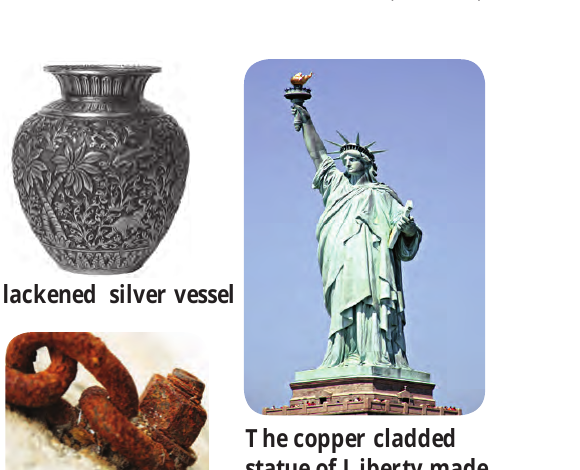
Examples
- Iron reacts with moist air and forms reddish rust, Fe2O3·H2O.
- Carbon dioxide in moist air reacts with copper and forms a greenish layer of copper carbonate, CuCO3. This is called patination of copper.
- Silver reacts with hydrogen sulphide and forms black silver sulphide, Ag2S.
- Oxidation of aluminium forms a thin layer of aluminium oxide.
Prevention of Corrosion – Galvanizing
Corrosion can be reduced by preventing direct contact of metal with air and moisture.
Painting, oiling, greasing and varnishing
A protective layer prevents contact of the metal with moisture and oxygen. However, painting is suitable only for a limited time because a scratch can expose the metal.
Galvanizing
A thin layer of zinc is applied to iron or steel to prevent corrosion.
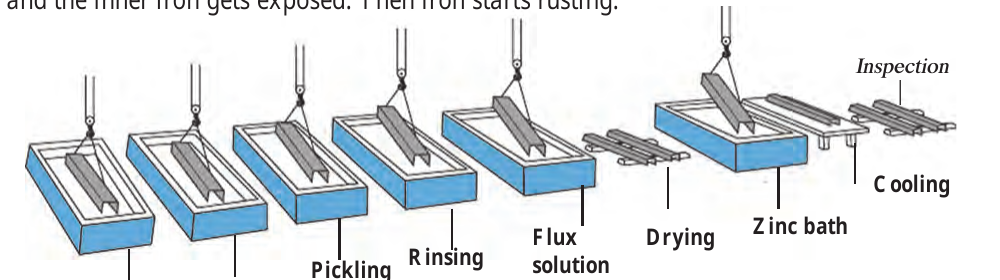
Zinc is more electropositive than iron, so zinc corrodes first and protects the iron underneath.
Tinning and Anodization
Tinning
A layer of molten tin is deposited on a metal surface. This is called tinning or kalhaee. It is used to prevent damage due to corrosion and the poisonous greenish layer that can form on copper or brass vessels.
Anodization
Metals such as copper and aluminium are coated with a thin and strong layer of their oxides by electrolysis.
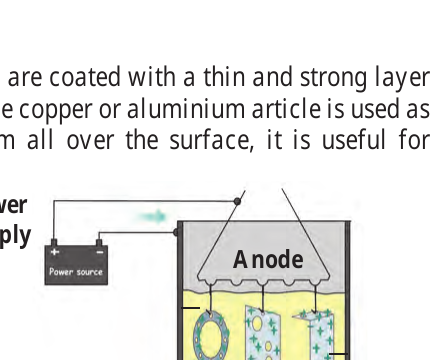
In anodization, the copper or aluminium article is used as the anode. In aluminium, the oxide layer prevents contact with oxygen and water and prevents further oxidation.
Electroplating and Alloying
Electroplating
Electroplating is the process in which a less reactive metal is coated on a more reactive metal by electrolysis.
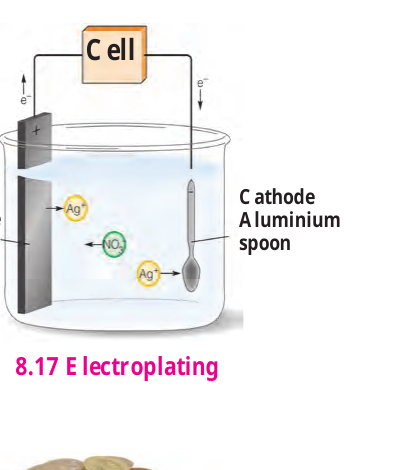
Examples: silver-plated spoons and gold-plated ornaments.
Alloying
An alloy is a homogeneous mixture formed by mixing a metal with other metals or nonmetals in a certain proportion.
Bronze contains 90% copper and 10% tin. Stainless steel contains 74% iron, 18% chromium and 8% carbon.
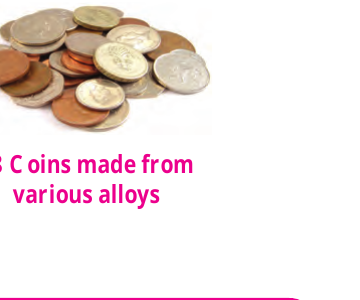
When one of the metals in an alloy is mercury, the alloy is called an amalgam. Examples include sodium amalgam and zinc amalgam.
Board Exam Quick Revision
Important definitions
- Metallurgy: science and technology of extraction and purification of metals.
- Mineral: naturally occurring metal compound with impurities.
- Ore: mineral from which metal can be separated economically.
- Gangue: soil, sand and rocky impurities present in ore.
- Concentration: separation of gangue from ore.
- Roasting: strong heating of sulphide ore in air.
- Calcination: strong heating of carbonate ore in limited air.
- Alloy: homogeneous mixture of metals or a metal with a nonmetal in a certain proportion.
- Electroplating: coating a less reactive metal on a more reactive metal by electrolysis.
For a 2–4 mark answer: write the definition first, then 2–4 clear points, and add the correct textbook reaction or example wherever the question asks for it.