Lenses
A lens is a transparent medium bounded by two surfaces. Lenses are used in spectacles, telescopes, microscopes and many other optical instruments.
A ray of light gets refracted twice while passing through a lens: once while entering the lens and once while emerging from it. The direction of the ray changes because of these refractions.
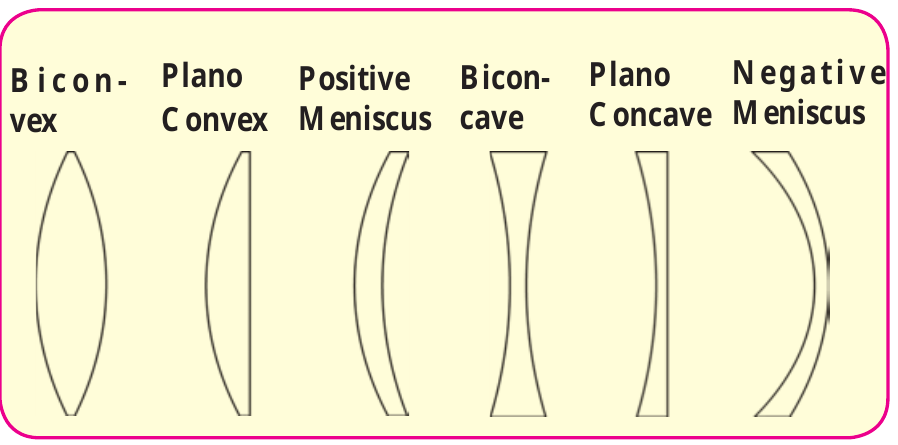
- Types and terms related to lenses
- Ray diagrams and image formation
- Sign convention, lens formula and magnification
- Power and combination of lenses
- Human eye and defects of vision
- Optical instruments and persistence of vision
Convex and Concave Lenses
Convex lens
A lens with two spherical surfaces puffed up outwards is called a convex or double convex lens. It is thicker near the centre than at the edges.
A convex lens is a converging lens because parallel rays of light converge after refraction.
Concave lens
A lens with both surfaces spherical on the inside is called a concave or double concave lens. It is thinner at the centre than at the edges.
A concave lens is a diverging lens because parallel rays of light diverge after refraction.
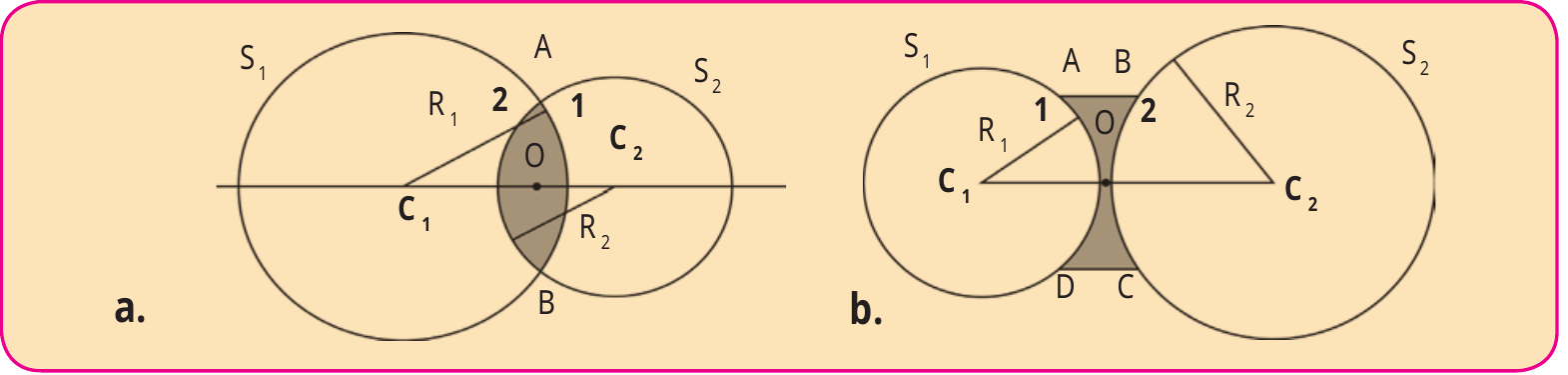
Terms Related to a Lens
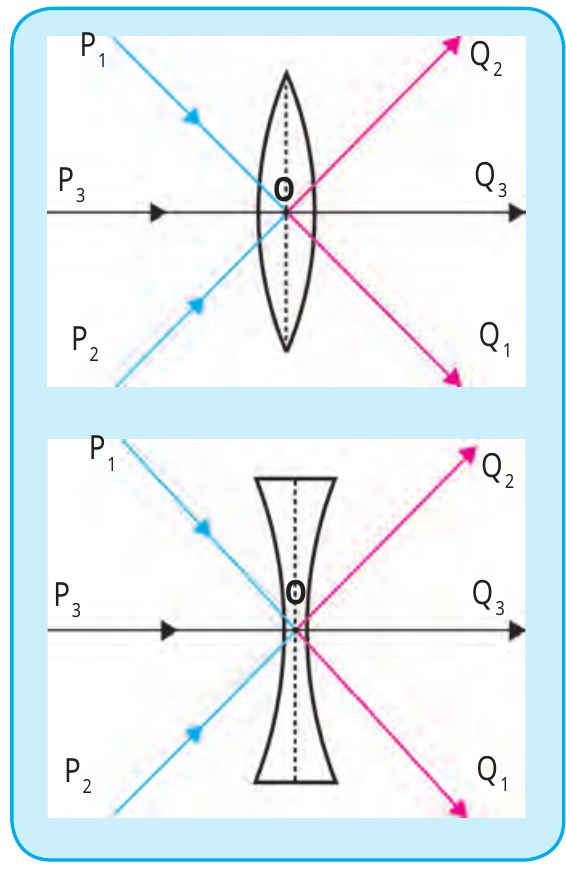
Centre of curvature (C)
The centres of the spheres whose parts form the surfaces of the lenses are called centres of curvatures of the lenses. A lens with both surfaces spherical has two centres of curvature, C₁ and C₂.
Radius of curvature (R)
The radii of the spheres whose parts form the surfaces of the lens are called the radii of curvature, R₁ and R₂.
Principal axis
The imaginary line passing through both centres of curvature is called the principal axis of the lens.
Optical centre (O)
The point inside a lens on the principal axis through which light rays pass without changing their path is called the optical centre of the lens.
Principal Focus and Focal Length
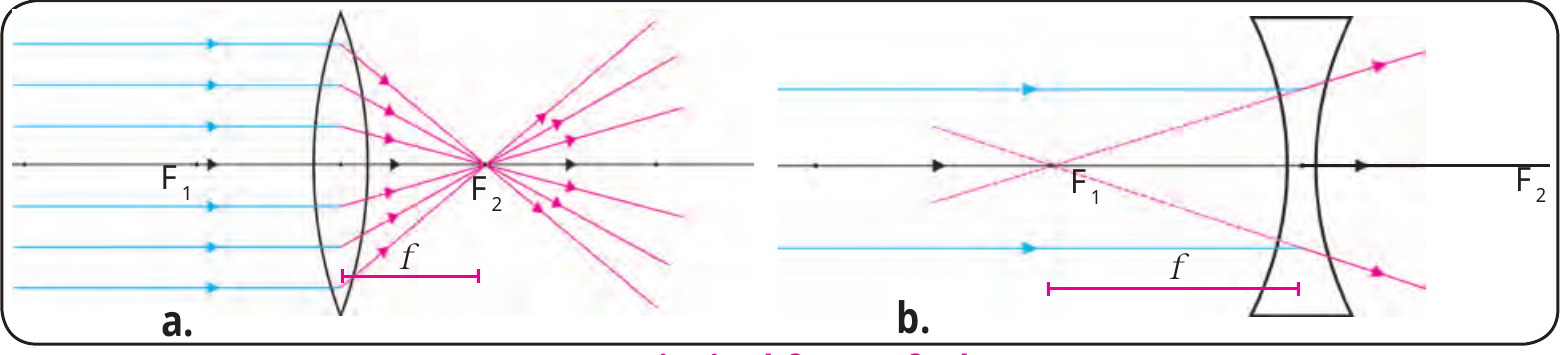
Principal focus
When light rays parallel to the principal axis are incident on a convex lens, they converge to a point on the principal axis. This point is called the principal focus of the convex lens.
For a concave lens, parallel rays diverge after refraction in such a way that they appear to be coming out of a point on the principal axis. This point is called the principal focus.
Convex lens → converging lens. Concave lens → diverging lens.
Focal length
The distance between the optical centre and principal focus of a lens is called its focal length.
Ray Diagram Rules
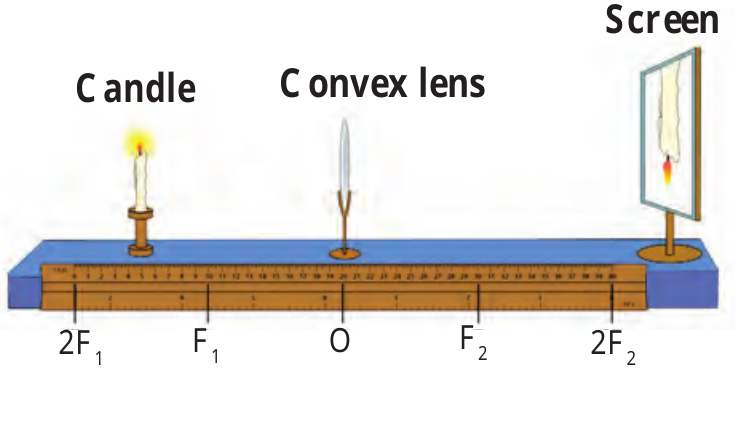
When the incident ray is parallel to the principal axis, the refracted ray passes through the principal focus.
When the incident ray passes through the principal focus, the refracted ray is parallel to the principal axis.
When the incident ray passes through the optical centre of the lens, it passes without changing its direction.
For ray diagrams, draw the principal axis first, mark O, F and 2F, and use two standard rays to locate the image.
Images Formed by a Convex Lens
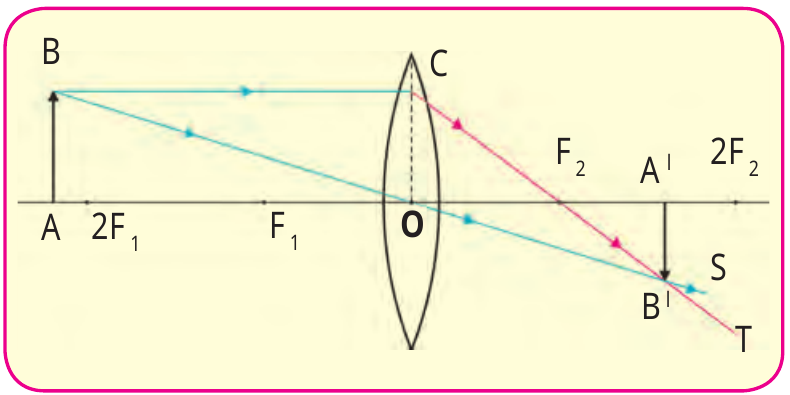
The position, size and nature of the image formed by a convex lens depend on the position of the object.
| Object position | Image position | Size | Nature |
|---|---|---|---|
| At infinity | At focus F₂ | Point | Real, inverted |
| Beyond 2F₁ | Between F₂ and 2F₂ | Smaller | Real, inverted |
| At 2F₁ | At 2F₂ | Same size | Real, inverted |
| Between F₁ and 2F₁ | Beyond 2F₂ | Larger | Real, inverted |
| At F₁ | At infinity | Very large | Real, inverted |
| Between F₁ and O | Same side as object | Very large | Virtual, erect |
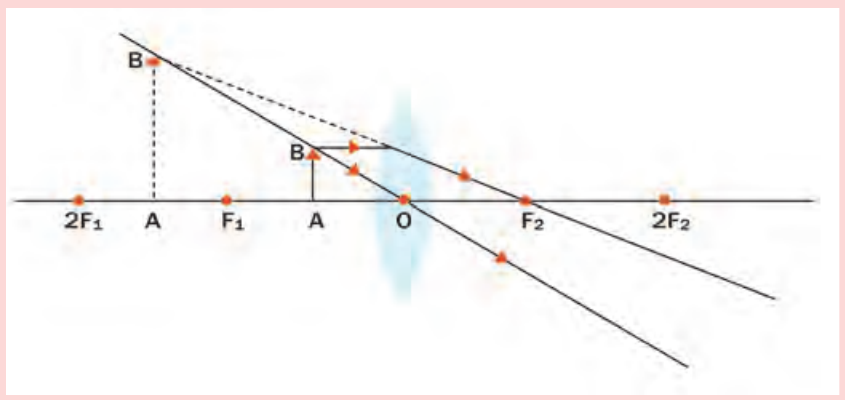
Convex Lens – Important Cases
Object beyond 2F₁
The image is formed between F₂ and 2F₂. It is real, inverted and smaller than the object.
When an object is placed beyond 2F₁, its image is formed between F₂ and 2F₂. The image is real, inverted and smaller than the object.
Object at 2F₁
The image is formed at 2F₂. It is real, inverted and of the same size as the object.
Object between F₁ and 2F₁
The image is formed beyond 2F₂. It is real, inverted and larger than the object.
Object at F₁
The refracted rays become parallel and the image is formed at infinity. The image is very large, real and inverted.
Object between F₁ and O
The image is formed on the same side of the lens as the object. It is very large, virtual and erect.
Concave Lens – Image Formation
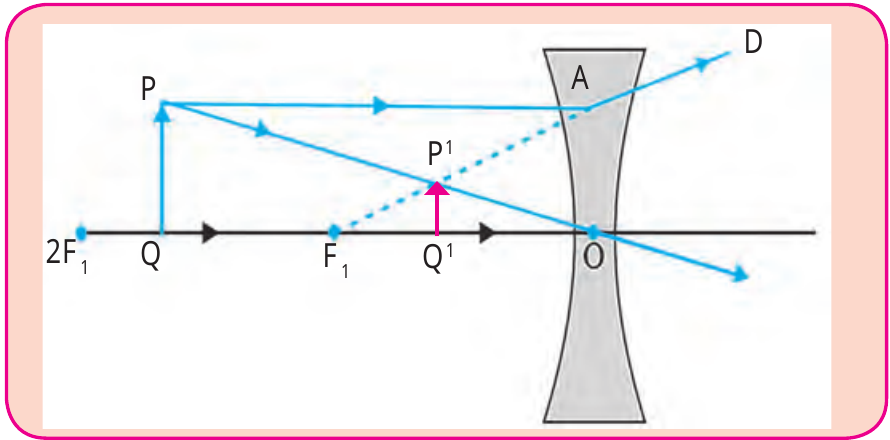
A concave lens forms an image for different object positions using the standard ray rules.
| Object position | Image position | Size | Nature |
|---|---|---|---|
| At infinity | At first focus F₁ | Point | Virtual and erect |
| Anywhere between O and infinity | Between O and F₁ | Small | Virtual and erect |
A concave lens always forms a virtual, erect and smaller image.
Cartesian Sign Convention
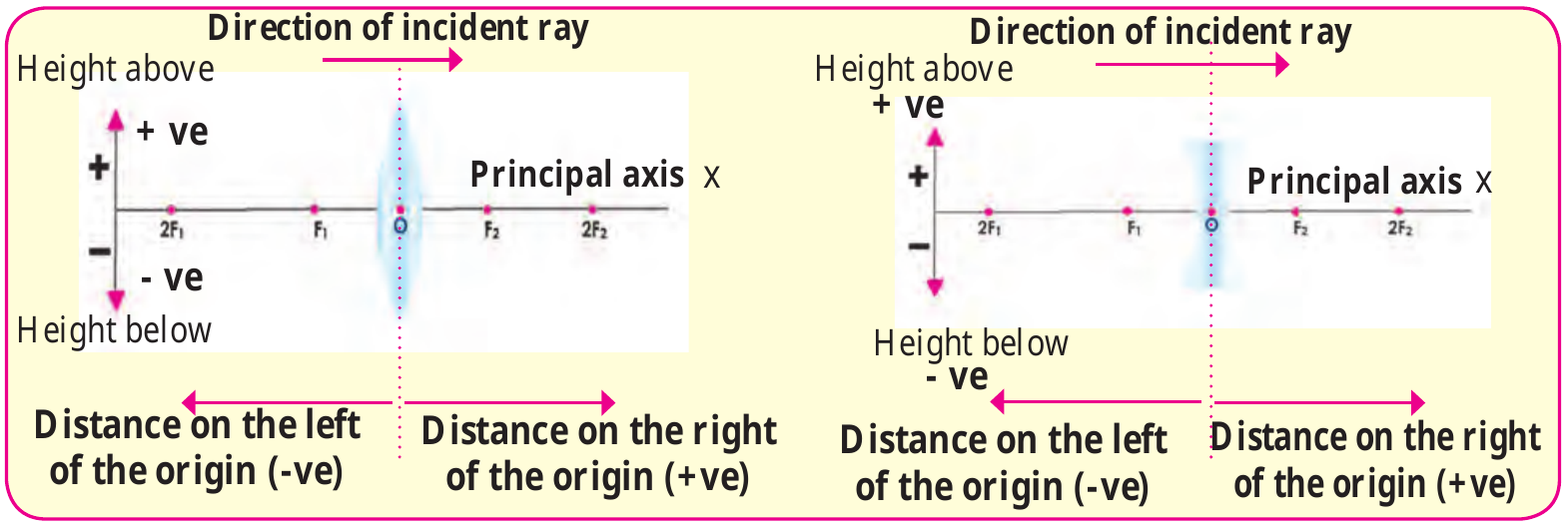
According to the Cartesian sign convention, the optical centre O is taken as the origin and the principal axis is the X-axis.
- The object is always placed on the left of the lens.
- Distances measured to the right of O are positive.
- Distances measured to the left of O are negative.
- Distances perpendicular to the principal axis and above it are positive.
- Distances perpendicular to the principal axis and below it are negative.
- The focal length of a convex lens is positive.
- The focal length of a concave lens is negative.
Do not use centimetres directly in the power formula. Convert focal length into metres before calculating power in dioptres.
Lens Formula
The formula showing the relation between the distance of the object, the distance of the image and the focal length is called the lens formula.
Write Given → Sign convention → Formula → Substitution → Calculation → Final answer with unit and nature of image.
Numerical 1 – Image Position and Magnification
Example
An object is placed 20 cm from a convex lens. The focal length is 10 cm and the object height is 5 cm. Find the image position, image height and magnification.
Given: u = −20 cm, f = +10 cm, h₁ = 5 cm
1v − 1−20 = 110
1v + 120 = 110
1v = 120 ⇒ v = +20 cm
Magnification:
M = vu = +20−20 = −1
h₂ = M × h₁ = −1 × 5 = −5 cm
Answer: Image is formed 20 cm on the other side. Its height is 5 cm, it is real and inverted, and its size is equal to the object.
Magnification
The magnification due to a lens is the ratio of the height of the image to the height of the object.
Here h₂ is the height of the image and h₁ is the height of the object. The relation with u and v is useful for numerical problems.
- Negative magnification → inverted image.
- Positive magnification → erect image.
Power of a Lens
The capacity of a lens to converge or diverge incident rays is called its power. Power is the inverse of focal length, when focal length is expressed in metres.
Unit: Dioptre (D)
Convex lens → positive power. Concave lens → negative power.
Example
A convex lens has focal length 20 cm. Find its power.
f = 20 cm = 0.20 m
P = 10.20 = 5 D
Answer: Power of the lens = +5 D.
Combination of Lenses
If two lenses with focal lengths f₁ and f₂ are kept in contact, the effective power of their combination is the sum of their individual powers.
Therefore, for three lenses:
P = P₁ + P₂ + P₃
Example
Three lenses have powers 2 D, 2.5 D and 1.7 D. Find total power.
P = 2 + 2.5 + 1.7 = 6.2 D
Answer: Total power = +6.2 D.
Human Eye – Construction and Working
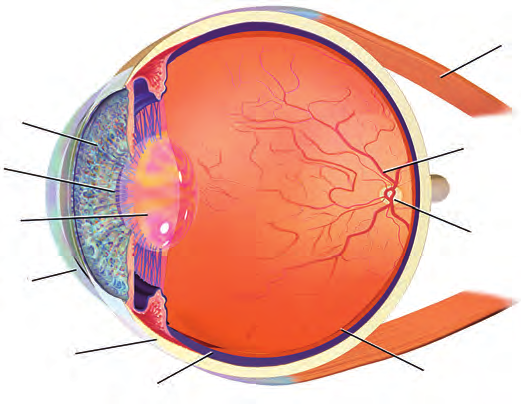
The cornea is a very thin transparent cover through which light enters the eye. The iris is a dark, fleshy screen behind the cornea. A small opening at the centre of the iris is called the pupil.
The pupil controls the amount of light entering the eye. Behind the pupil is a double convex crystalline lens. This lens makes small adjustments of focal length to focus the image.
The lens creates a real and inverted image on the retina. Retina contains light-sensitive cells. The signals are conveyed to the brain through the optic nerve.
Functions
- Cornea: admits and strongly refracts incoming light.
- Iris: controls pupil size.
- Pupil: controls the amount of light entering the eye.
- Crystalline lens: focuses the image.
- Retina: receives the image and generates electrical signals.
- Optic nerve: carries signals to the brain.
Accommodation, Near Point and Far Point
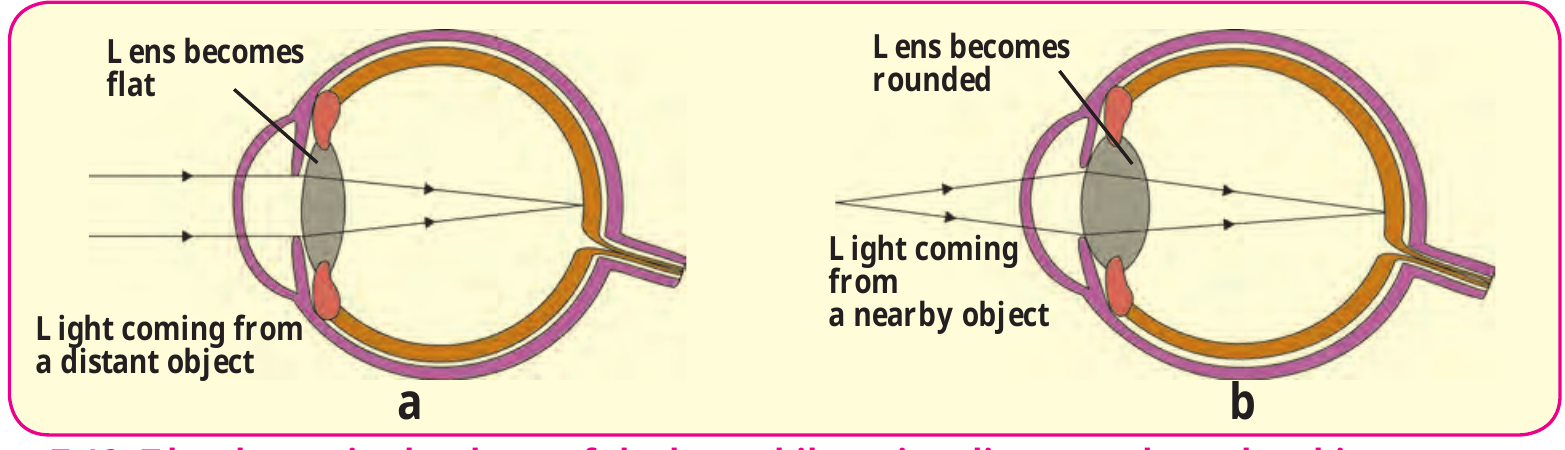
While seeing distant objects, the lens of the eye becomes flat and its focal length increases. While seeing nearby objects, the lens becomes more rounded and its focal length decreases.
The capacity of the eye lens to change its focal length as per need is called its power of accommodation.
The minimum distance at which an object is clearly visible without stress is the minimum distance of distinct vision. For a normal human eye it is 25 cm, called the near point.
The farthest distance at which an object is clearly visible without stress is the far point. For a normal human eye, the far point is at infinity.
Near point = 25 cm | Far point = ∞
Myopia / Nearsightedness
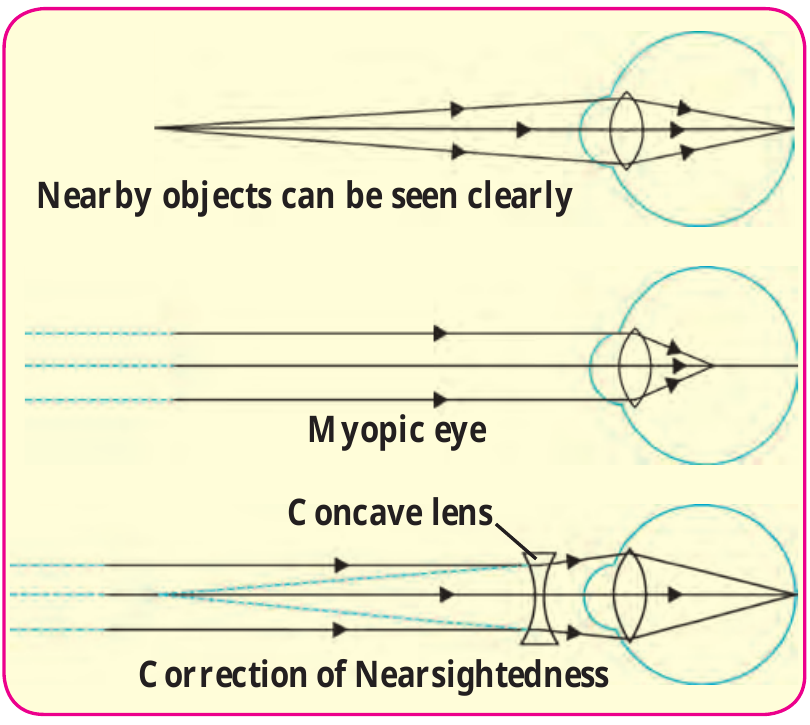
In nearsightedness or myopia, the eye can see nearby objects clearly but distant objects appear indistinct. The far point is not at infinity but shifts closer to the eye.
In myopia, the image of a distant object forms in front of the retina.
Causes
- The curvature of the cornea and eye lens increases, so converging power remains large.
- The eyeball elongates, increasing the distance between lens and retina.
Correction
Myopia is corrected by using a concave lens of suitable focal length. The concave lens diverges incident rays so that the eye lens can form the image on the retina.
Myopia is corrected using a concave lens having negative power.
Hypermetropia / Farsightedness
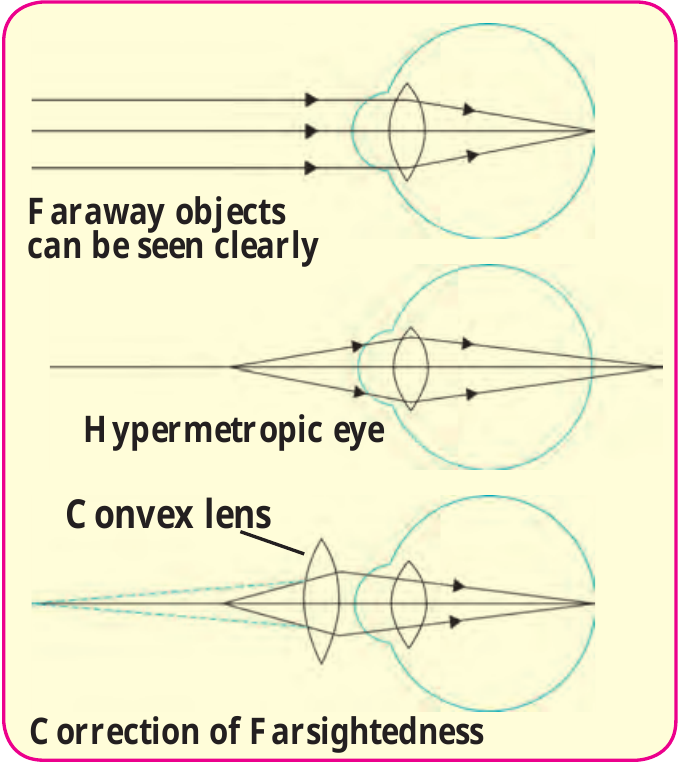
In farsightedness or hypermetropia, the eye can see distant objects clearly but cannot see nearby objects distinctly. The near point shifts farther away from the eye.
In this defect, the image of a nearby object forms behind the retina.
Causes
- The curvature of the cornea and eye lens decreases, so converging power becomes less.
- The eyeball becomes flatter and the distance between lens and retina decreases.
Correction
Hypermetropia is corrected by using a convex lens of suitable focal length. The convex lens converges incident rays before they reach the eye lens.
Hypermetropia is corrected using a convex lens having positive power.
Presbyopia and Bifocal Lenses
Presbyopia
Generally, the focusing power of the eye lens decreases with age. The muscles near the lens lose their ability to change the focal length. The near point shifts farther from the eye and old people cannot see nearby objects clearly.
The age-related defect due to decrease in focusing power of the eye lens is called presbyopia.
Bifocal lens
Sometimes a person suffers from nearsightedness as well as farsightedness. In such a case bifocal lenses are required.
- Upper part → concave lens → corrects nearsightedness.
- Lower part → convex lens → corrects farsightedness.
Myopia → concave lens. Hypermetropia → convex lens. Presbyopia may require bifocal lenses depending on the defects present.
Apparent Size and Uses of Lenses
For two objects of the same size kept at different distances from the eye, the nearer object appears bigger because it subtends a larger angle at the eye. Thus apparent size depends on the angle subtended by the object at the eye.
Uses of concave lenses
- Medical equipment, scanners and CD players.
- Peepholes in doors.
- Spectacles for correcting myopia.
- Torches to spread light widely.
- Some optical arrangements in cameras, telescopes and microscopes.
Uses of convex lenses
- Simple microscope
- Compound microscope
- Telescope
- Camera
- Projector
- Spectrograph
Simple and Compound Microscope
Simple microscope
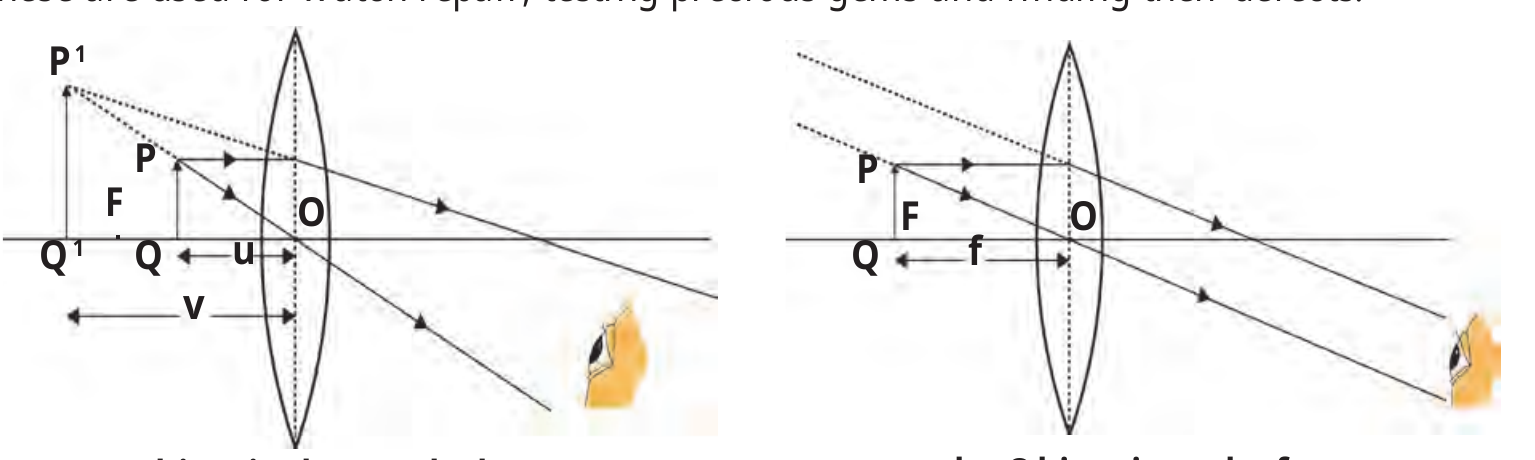
A convex lens with small focal length produces a virtual, erect and bigger image of an object. Such a lens is called a simple microscope or magnifying lens. It is used for watch repair, testing precious gems and finding their defects.
Compound microscope
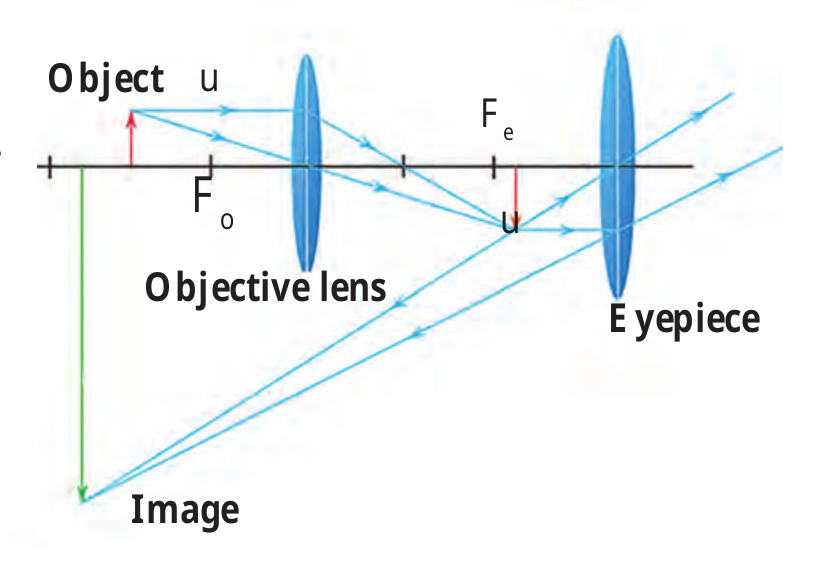
A compound microscope is made of two convex lenses: objective and eyepiece. The objective has smaller cross-section and smaller focal length. The eyepiece has larger focal length than the objective. Higher magnification is obtained by the combined effect of the two lenses.
The image formed by the first lens acts as the object for the second lens.
Telescope
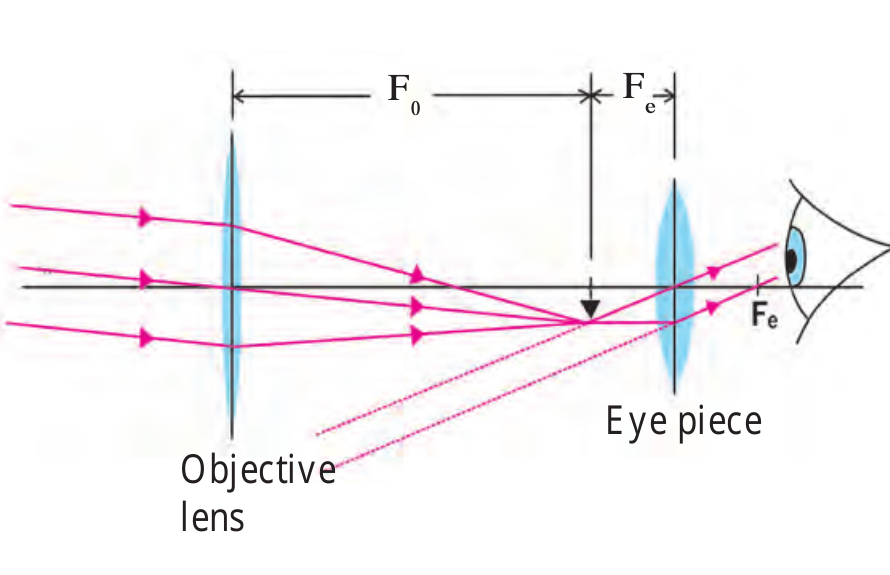
A telescope is used to see distant objects clearly in magnified form. Astronomical telescopes are used to observe stars and planets.
Types
- Refracting telescope: uses lenses.
- Reflecting telescope: uses mirrors and also lenses.
In both types, the image formed by the objective acts as the object for the eyepiece. The objective lens has large diameter and larger focal length so that maximum light from the distant object can be collected.
Persistence of Vision and Colour Vision
Persistence of vision
The image remains imprinted on the retina for about 116 second after the object is removed. The sensation on the retina persists for a while. This is called persistence of vision.
The phenomenon in which the image remains impressed on the retina for about 116 second after the object is removed is called persistence of vision.
Colour vision
Retina contains rod-like and cone-like light-sensitive cells. Rod cells respond to intensity of light and give information about brightness or dimness. Cone cells respond to colours.
Conical cells respond differently to red, green and blue colours. Some people lack cone cells responding to certain colours and are therefore unable to recognize or distinguish those colours. Such persons are said to be colour blind.
Important Numericals – Quick Practice
1. Power from +1.5 D
A doctor prescribes a lens of power +1.5 D. Find focal length and type.
f = 1P = 11.5 = +0.67 m
Answer: +0.67 m, convex lens; it is used for farsightedness.
2. Converging lens
A 5 cm high object is placed 25 cm from a converging lens of focal length 10 cm. Using the lens formula gives image distance ≈ 16.7 cm and image height ≈ 3.3 cm. The image is real and inverted.
3. Virtual image
An object is kept 60 cm from a lens and a virtual image is formed 20 cm in front of the lens. Using u = −60 cm and v = −20 cm in the lens formula gives f = −30 cm. Therefore the lens is diverging (concave).
Board Exam Quick Revision
Must-Remember Formulae
- Lens formula: 1v − 1u = 1f
- Magnification: M = h₂h₁ = vu
- Power: P = 1f(m)
- Combination of lenses: P = P₁ + P₂
Most Important Questions
- Define convex lens, concave lens, optical centre, principal focus and focal length.
- State the three rules for drawing ray diagrams.
- Explain image formation by a convex lens for different object positions.
- Why is a concave lens called a diverging lens?
- State Cartesian sign convention for lenses.
- Derive/use the lens formula in numerical problems.
- Explain power of a lens and its unit.
- Explain the construction and working of human eye.
- Explain myopia, hypermetropia and presbyopia with corrections.
- Explain simple microscope, compound microscope and telescope.
- Explain persistence of vision and colour vision.
For numerical problems always show the sign convention and unit conversion. For defects of vision draw the eye, show where the image forms, name the correcting lens and explain how the correction shifts the image onto the retina.