Refraction of Light
Light generally travels in a straight line. However, when light passes from one transparent medium to another transparent medium, its direction changes. This change in direction is called refraction of light.
This chapter explains refraction through a glass slab, the laws of refraction, refractive index, atmospheric refraction, dispersion, partial reflection, total internal reflection and rainbow formation.
Learn the definitions, laws, formulae, ray diagrams, conditions for total internal reflection and the causes of atmospheric phenomena.
Meaning of Refraction
Light can change its direction when it passes from one transparent medium to another transparent medium. The change is observed because the light does not travel with the same velocity in all media.
For example, a pencil partly immersed in water appears bent or broken near the water surface. A coin that has disappeared from view can become visible when water is poured into the vessel. These observations are due to the change in direction of light.
The change in the direction of light while going from one transparent medium to another transparent medium is called refraction of light.
When light passes from one transparent medium to another transparent medium, its direction changes. This change in direction of light is called refraction of light.
Pencil and Coin Observations
Pencil in Water
When a pencil is partly dipped in water, the portion inside water appears thicker. If the pencil is inclined to the water surface, it appears to be broken near the surface of water. The observed effect is produced because the direction of light changes while coming out of water.
Coin in a Vessel
A coin kept in a vessel can disappear when the observer moves away. When water is slowly added, the coin becomes visible again after the water reaches a certain level. The light coming from the coin changes direction on passing from water to air and reaches the observer.
Both observations are everyday examples that demonstrate refraction of light.
Refraction Through a Glass Slab
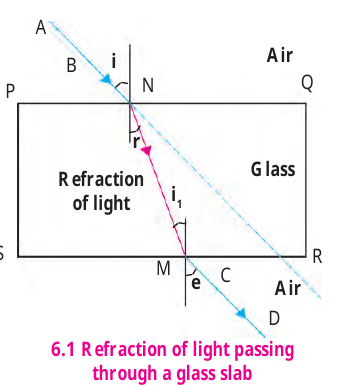
When a light ray enters a glass slab from air, it undergoes refraction at the first surface. When it comes out from the glass into air through the second parallel surface, it undergoes refraction again.
At the first surface the ray bends towards the normal because it enters the denser medium. At the second surface it bends away from the normal because it enters the rarer medium.
The changes in direction at the two parallel surfaces are equal but opposite. Hence, the emergent ray is parallel to the incident ray, but it is somewhat displaced from the original path.
The emergent ray from a glass slab is parallel to the incident ray because the changes in direction at the two parallel surfaces are equal but opposite. However, the emergent ray is laterally displaced.
Angles and Rays in a Glass Slab
Incident ray (AN): The ray falling on the first surface of the glass slab.
Refracted ray: The ray travelling inside the glass after refraction at the first surface.
Emergent ray (MD): The ray coming out of the glass slab into air.
Normal: The perpendicular drawn to the surface at the point of incidence.
Angle of incidence (i): The angle between the incident ray and the normal.
Angle of refraction (r): The angle between the refracted ray and the normal.
Angle of emergence (e): The angle between the emergent ray and the normal at the second surface.
For the arrangement shown in the textbook, the angle of emergence is equal to the angle of incidence: e = i.
Laws of Refraction
The refraction of light obeys two laws. These laws describe the positions of the incident ray, refracted ray and normal, and give the mathematical relation between the angles of incidence and refraction.
First Law
The incident ray and refracted ray at the point of incidence are on opposite sides of the normal to the surface. The incident ray, refracted ray and normal all lie in the same plane.
At the point of incidence, the incident ray, refracted ray and the normal to the surface lie in the same plane.
Second Law
For a given pair of media, the ratio of the sine of angle of incidence to the sine of angle of refraction remains constant.
Second Law of Refraction
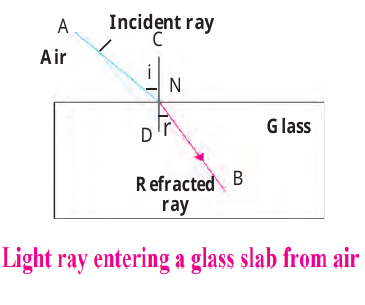
For a given pair of media, such as air and glass, the ratio of sin i to sin r is a constant. Here, i is the angle of incidence and r is the angle of refraction.
The second law of refraction states that, for a given pair of media, the ratio of sin i to sin r is constant. This law is also called Snell’s law.
Refractive Index
The change in direction of a light ray is different for different media. This change is related to the refractive index of the medium. The value of refractive index is different for different media and also for different colours of light in the same medium.
The refractive index of a medium with respect to vacuum is called its absolute refractive index. The refractive index depends on the velocity of light in the medium.
For a given pair of media, the ratio of sin i to sin r is called the refractive index of the second medium with respect to the first medium.
Refractive index is a property of the medium and also depends on the colour (frequency) of light.
Refractive Index and Velocity
Let the velocity of light in medium 1 be v₁ and the velocity of light in medium 2 be v₂. The refractive index of medium 2 with respect to medium 1 is equal to the ratio of the velocity of light in medium 1 to that in medium 2.
If the first medium is vacuum, the refractive index of the second medium is called its absolute refractive index and is represented by n.
How Light Bends
When a light ray passes from a rarer medium to a denser medium, it bends towards the normal. When it passes from a denser medium to a rarer medium, it bends away from the normal.
| Situation | Direction of bending |
|---|---|
| Rarer → Denser | Towards the normal |
| Denser → Rarer | Away from the normal |
| Normal incidence, i = 0° | No change in direction |
If a ray is incident normally at the boundary between two media, it does not change its direction and hence does not get refracted.
Light bends towards the normal while going from a rarer to a denser medium and bends away from the normal while going from a denser to a rarer medium.
Mirage
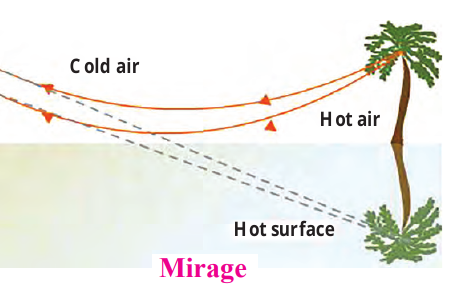
A mirage is an illusion of the appearance of water on a hot road or in a desert. The air near a hot surface is hotter and rarer than the air above it. The refractive index changes with height, so the direction of light rays coming from a distant object keeps changing according to the laws of refraction.
The light rays coming from a distant object appear to be coming from an image of the object inside the ground. This optical effect is called a mirage.
A mirage is an optical illusion produced due to atmospheric refraction in which a distant object appears to be reflected from the ground.
Twinkling of Stars
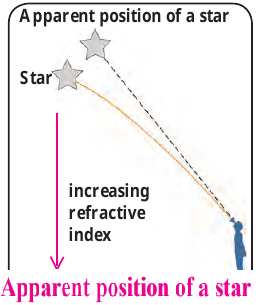
Stars are self-luminous and are very far from us. Therefore, they appear to be point sources. The density of air increases with decreasing height above the Earth’s surface, and the refractive index also increases.
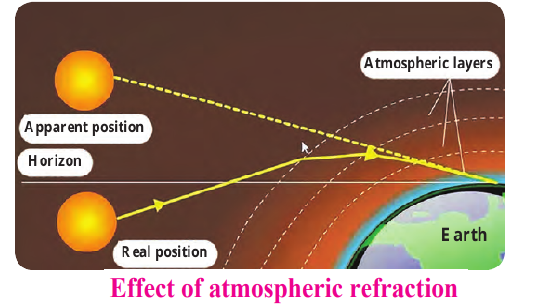
Star light travels from rarer to denser atmospheric layers and continuously bends towards the normal. The apparent position of the star changes because atmospheric air is in motion and its density and temperature change.
As the refractive index of air changes continuously, the apparent position and brightness of the star also change continuously. Hence, the star appears to twinkle.
Stars appear as point sources. Due to continuous changes in atmospheric density, temperature and refractive index, the direction and brightness of star light keep changing. Therefore, stars appear to twinkle.
Atmospheric Refraction Effects
Why planets do not twinkle
Planets are much closer to us compared with stars. They do not appear as point sources; they appear as a collection of point sources. Atmospheric changes affect individual point sources, but their average position and total average brightness remain almost unchanged. Hence planets do not twinkle.
Early Sunrise and Delayed Sunset
When the Sun is somewhat below the horizon, its light rays can reach us along a curved path due to refraction through the Earth’s atmosphere. Therefore, we see the Sun even before it emerges above the horizon. The same effect at sunset makes us see the Sun for a short while after it goes below the horizon.
Both early sunrise and delayed sunset are effects of atmospheric refraction.
Dispersion of Light
When light passes through a medium, different colours of light can travel with different velocities. Therefore, the refractive index of a medium is different for different colours. As a result, different colours undergo different amounts of refraction.
The visible wavelength range is approximately 400 nm to 700 nm. Red light has the maximum wavelength, close to 700 nm, while violet has the smallest wavelength, close to 400 nm.
The process of separation of light into its component colours while passing through a medium is called dispersion of light.
VIBGYOR → Violet, Indigo, Blue, Green, Yellow, Orange, Red.
Dispersion Through a Glass Prism
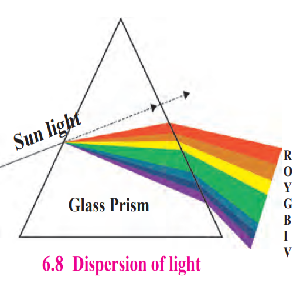
Sir Isaac Newton was the first person to use a glass prism to obtain the spectrum of sunlight. When white light is incident on a prism, different colours bend through different angles.
Among the seven colours, red bends the least and violet bends the most. Therefore, the colours emerge along different paths and become separated, producing a spectrum of seven colours.
White sunlight entering a glass prism is separated into seven colours because different colours have different refractive indices in the medium and hence are refracted through different angles.
Partial Reflection
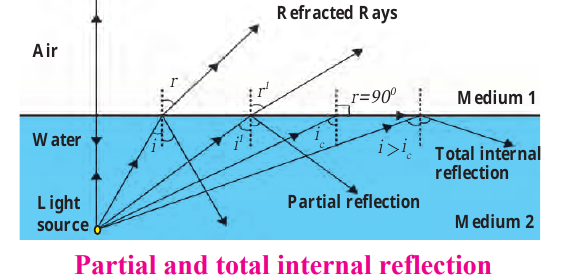
When light enters a rarer medium from a denser medium, it gets partially reflected. A part of the light is reflected back into the denser medium according to the laws of reflection, while the remaining part is refracted into the rarer medium.
When part of the incident light is reflected back into the denser medium and the remaining part is refracted into the rarer medium, the phenomenon is called partial reflection.
For light travelling from a denser to a rarer medium, the angle of incidence is smaller than the angle of refraction, and the ray bends away from the normal.
Critical Angle
Consider a light ray travelling from a denser medium to a rarer medium. If the angle of incidence is increased, the angle of refraction also increases according to Snell’s law.
For a particular value of the angle of incidence, the angle of refraction becomes exactly 90°. This particular value of the angle of incidence is called the critical angle.
The angle of incidence in the denser medium for which the angle of refraction in the rarer medium becomes 90° is called the critical angle.
The relation follows from Snell’s law because sin 90° = 1.
Total Internal Reflection
When light travels from a denser medium to a rarer medium and the angle of incidence becomes greater than the critical angle, the angle of refraction would be greater than 90°. Such a ray cannot pass into the rarer medium in the ordinary refracted direction.
Instead, the light returns completely into the denser medium. Thus, all the light gets reflected back into the denser medium. This phenomenon is called total internal reflection.
The phenomenon in which all the incident light is reflected back into the denser medium when it travels from a denser medium to a rarer medium with angle of incidence greater than the critical angle is called total internal reflection.
- Light must travel from a denser medium to a rarer medium.
- The angle of incidence must be greater than the critical angle.
Rainbow Production
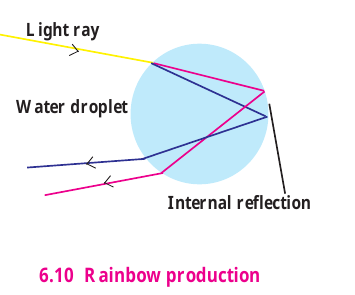
A rainbow is a beautiful natural phenomenon seen mainly after rainfall. Small water droplets act as small prisms. When sunlight enters these droplets, the light is refracted and dispersed.
The dispersed light then undergoes internal reflection inside the water droplet. When the light comes out of the droplet, it is refracted again. These three processes together produce the rainbow.
A rainbow is produced by the combined effect of refraction, dispersion and total internal reflection of sunlight in small water droplets.
Board Exam Revision
Must-Remember Formulae
- Snell’s law: sin i / sin r = n
- Relative refractive index: ¹n₂ = v₁ / v₂
- Absolute refractive index: n = c / v
- At critical angle: i = C, r = 90°
- For total internal reflection: i > C
Most Important Board Questions
- Define refraction of light.
- State the two laws of refraction.
- Explain refractive index and write its formula.
- Explain why stars twinkle.
- Explain why planets do not twinkle.
- Explain mirage.
- Explain dispersion of light and name the seven colours.
- Explain partial reflection and total internal reflection.
- Define critical angle and state the conditions for total internal reflection.
- Explain the formation of rainbow.
For a 3–4 mark answer, write the definition first, then explain the process in logical steps and add the relevant formula or labelled ray diagram wherever required.