Heat
Detailed Notes
- Latent heat and change of state.
- Regelation and anomalous behaviour of water.
- Dew point, humidity and relative humidity.
- Specific heat capacity and heat exchange.
Read one topic at a time and observe the figures carefully.
Latent Heat – Heating Ice
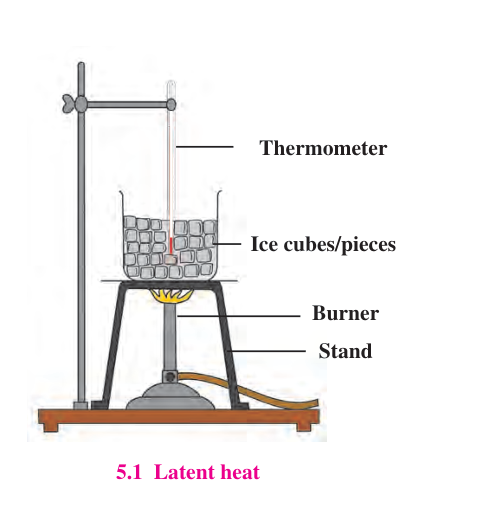
- When ice is heated, it starts melting. The mixture remains at 0°C until all the ice melts.
- Even though heat is supplied, the temperature does not rise during the change of state.
- The absorbed heat is used to weaken bonds and transform the solid into liquid.
Latent Heat of Fusion
- The constant temperature at which ice changes into water is called the melting point of ice.
- The heat energy absorbed at constant temperature during transformation of solid into liquid is called as latent heat of fusion.
- Specific latent heat of fusion is the heat absorbed at constant temperature by unit mass of a solid to convert it into liquid phase.
Latent Heat of Vaporization
- After all ice becomes water, the temperature rises from 0°C to 100°C.
- At 100°C, water changes into steam while its temperature remains constant.
- The heat absorbed at constant temperature during liquid-to-gas transformation is called as latent heat of vaporization.
- Specific latent heat of vaporization is the heat absorbed at constant temperature by unit mass of a liquid to convert into gaseous phase.
Temperature vs Time Graph
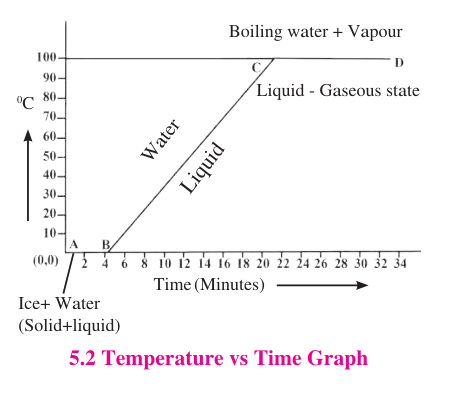
- AB: Ice changes into water at 0°C. Heat is absorbed, but temperature remains constant.
- BC: Water temperature rises from 0°C to 100°C.
- CD: Water changes into steam at 100°C. Temperature again remains constant.
The flat parts of the graph represent change of state.
Regelation
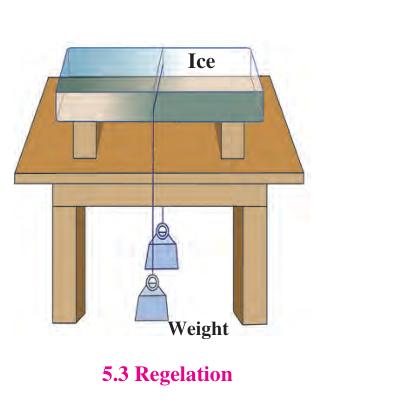
- A metal wire with equal weights is placed over a slab of ice. The wire gradually penetrates the ice, but the slab does not break.
- The phenomenon in which ice converts into liquid due to applied pressure and then reconverts into ice when pressure is removed is called as regelation.
- Pressure lowers the melting point of ice below 0°C. When pressure is removed, the melting point is restored to 0°C.
Anomalous Behaviour of Water
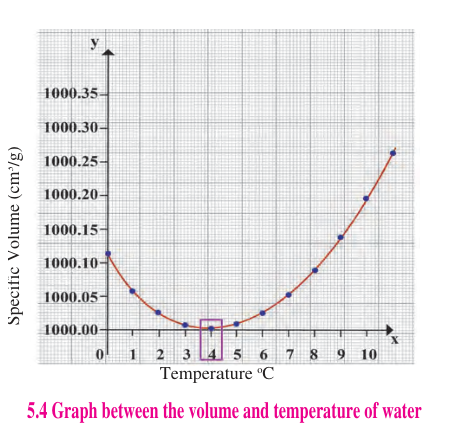
- Normally, liquids expand on heating and contract on cooling. Water behaves differently between 0°C and 4°C.
- When water is heated from 0°C to 4°C, it contracts. At 4°C its volume is minimum.
- Above 4°C, water expands normally. Therefore, water has maximum density at 4°C.
Construction
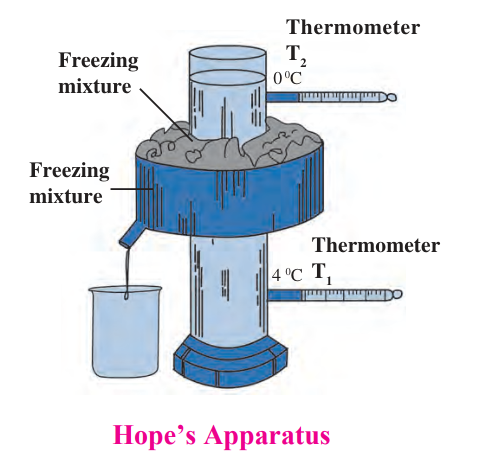
- Hope’s apparatus has a cylindrical container with a flat bowl around its middle.
- Two thermometers are fitted above and below the flat bowl: T₂ above and T₁ below.
- Water is filled in the cylinder and a freezing mixture of ice and salt is placed in the flat bowl.
Working
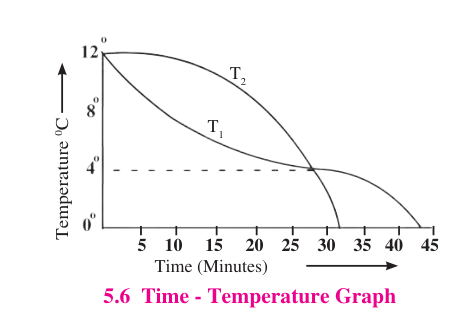
- Initially T₁ and T₂ are the same. As cooling starts, T₁ in the lower part falls faster than T₂.
- When T₁ reaches 4°C, it remains almost steady for some time. Water at 4°C has maximum density and moves downward.
- Below 4°C, water expands and its density decreases, so it moves upward. T₂ reaches 0°C first.
The intersection of the curves shows the temperature of maximum density.
Aquatic Life in Cold Regions
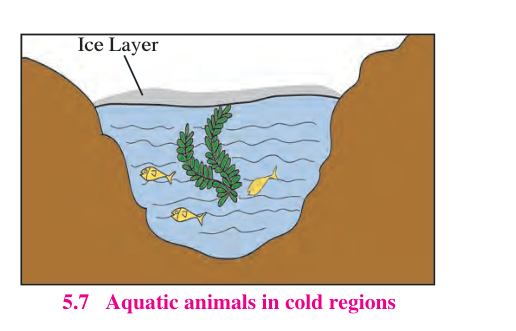
- In cold regions, the upper layer of a water body freezes and forms an ice layer.
- Water at 4°C has maximum density and moves downward. Water below the ice remains liquid.
- Therefore aquatic plants and animals can survive even when atmospheric temperature goes below 0°C.
- In winter, expansion of freezing water can also make water-supply pipes break and rocks crack.
Dew Point
- For a given volume of air at a particular temperature, there is a limit to the amount of water vapour it can contain.
- When unsaturated air is cooled, a temperature is reached at which it becomes saturated with vapour.
- This temperature is called as dew point temperature.
- When air cools further, excess water vapour changes into tiny water droplets.
The temperature at which unsaturated air becomes saturated with vapour on cooling is called as dew point temperature.
Humidity and Saturated Air
- The moisture present in the atmosphere is called as humidity.
- When air contains the maximum possible amount of water vapour at a given temperature, it is said to be saturated with vapour.
- If the vapour content is less than the maximum limit, the air is unsaturated.
- At 40°C, air can contain about 49 g of water vapour per kilogram of dry air without condensation; at 20°C it can contain about 14.7 g.
The amount of vapour needed to saturate air depends on its temperature.
Relative Humidity
- The ratio of actual water vapour content to the amount required to saturate the same volume of air at the same temperature is called as relative humidity.
- At the dew point, relative humidity is 100%.
- If relative humidity is more than 60%, we feel the air is humid. If it is less than 60%, we feel the air is dry.
- A white trail behind an aeroplane can last longer when surrounding relative humidity is high.
Unit of Heat and Joule
- The SI unit of heat is joule (J). The CGS unit is calorie (cal).
- One calorie is the heat needed to raise 1 g of water by 1°C from 14.5°C to 15.5°C.
- One kilocalorie is the heat needed to raise 1 kg of water by 1°C over the same interval.
- 1 kcal = 1000 cal and 1 cal = 4.18 J.
James Prescott Joule showed that energy can be converted from one form to another. The unit of heat is called Joule (J) after him.
Specific Heat Capacity – Experiment
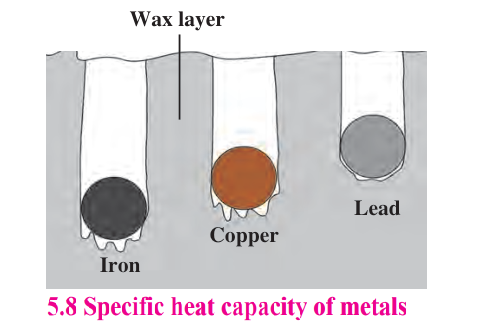
- Equal-mass iron, copper and lead spheres are heated to 100°C and placed on a thick wax slab.
- Iron goes deepest into the wax, lead the least, and copper an intermediate distance.
- This shows that different substances absorb different amounts of heat for the same rise in temperature.
Specific Heat
- The amount of heat energy required to raise the temperature of a unit mass of an object by 1°C is called as specific heat.
- Specific heat is denoted by c.
- SI unit: J/(kg°C).
- CGS unit: cal/(g°C).

Heat Absorbed / Heat Lost
- If the specific heat is c, mass is m, and temperature rises by ΔT, the heat energy absorbed is given by the relation below.
- If the temperature decreases by ΔT, the heat energy lost is also equal in magnitude.
Heat Exchange and Calorimeter
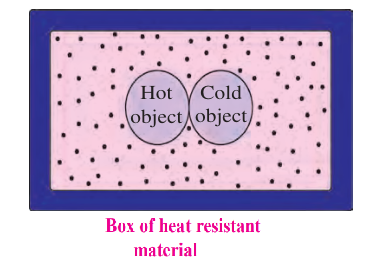
- When a hot and cold object exchange heat, the cold object's temperature rises and the hot object's temperature falls until both reach the same temperature.
- In an isolated system, heat energy lost by the hot object equals heat energy gained by the cold object. This is called as the principle of heat exchange.
- In the mixing method, a hot solid is placed in water in a calorimeter until the solid, water and calorimeter reach the same temperature.
Heat Energy
Question: How much heat energy is necessary to raise the temperature of 5 kg of water from 20°C to 100°C?
- Given: m = 5 kg, c = 1 kcal/(kg°C), ΔT = 100 − 20 = 80°C.
- Use: Q = m × c × ΔT.
- Q = 5 × 1 × 80 = 400 kcal.
400 kcal of heat energy is required.
Heat Exchange – Final Temperature
A 100 g copper sphere at 100°C is placed in 195 g water at 20°C in a 50 g copper calorimeter.
- Specific heat of copper and calorimeter = 0.1 cal/(g°C).
- Heat lost by copper sphere = heat gained by water + heat gained by calorimeter.
- Using the heat-exchange equation gives the final temperature T = 23.8°C.
Heat lost = Heat gained