Space Missions
Substantial developments in space technology made space voyage possible. Space missions are undertaken to place artificial satellites in orbit and to send spacecrafts into outer space for close observation of objects in the solar system.
Two broad categories
- Missions that put artificial satellites into Earth orbits for research and useful applications.
- Missions that send spacecrafts to outer space to observe and understand objects in the solar system or beyond.
Important milestones: Yuri Gagarin – 1961; Neil Armstrong – 1969; Rakesh Sharma – 1984; Kalpana Chawla and Sunita Williams participated in NASA missions.
Need and Importance of Space Missions
- The world has become a global village due to space missions.
- Communication with a person in any part of the world is possible within a second.
- Worldwide events can be observed from home.
- Internet makes information available at our fingertips.
- Advance alerts about natural calamities help in taking precautions.
- Satellites can be used for aerial surveillance.
- Fossil reserves and minerals can be explored.
- Space technology is an important part of national development.
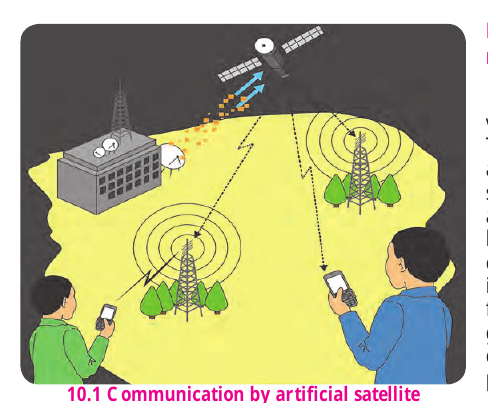
Artificial Satellite
A manmade object that revolves around the earth or any other planet in a fixed orbit is called an artificial satellite.
The Moon is the only natural satellite of the Earth. The first artificial satellite, Sputnik, was sent to space by the Soviet Union in 1957.
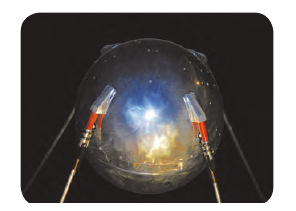
- Satellites work on solar energy.
- Solar photovoltaic panels are attached to satellites.
- Instruments receive and transmit signals.
- Other instruments are installed according to the satellite function.
Types of Artificial Satellites
| Type | Function | Indian series / launcher |
|---|---|---|
| Weather | Study and prediction of weather | INSAT, GSAT – GSLV |
| Communication | Communication between different locations | INSAT, GSAT – GSLV |
| Broadcast | Telecasting television programmes | INSAT, GSAT – GSLV |
| Navigational | Precise latitude and longitude | IRNSS – PSLV |
| Military | Security information | — |
| Earth Observation | Forests, deserts, oceans, polar ice, resources and calamities | IRS – PSLV |
Orbits of Artificial Satellites
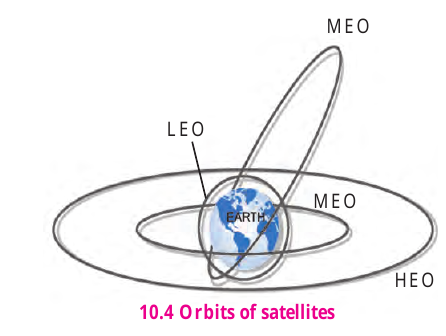
All artificial satellites do not revolve in similar orbits. The function of the satellite decides the height, nature of orbit and its inclination with respect to the equator.
A satellite is taken to the required height using a satellite launcher and is given a specific tangential velocity called critical velocity.
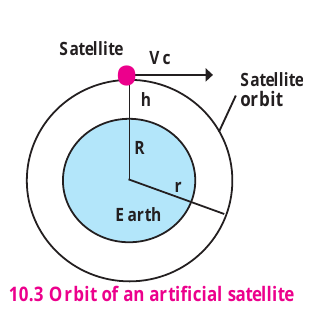
Critical Velocity
For a satellite of mass m revolving at height h above Earth, the orbital radius is R+h.
Centripetal force:
Gravitational force:
Equating the two forces:
Critical velocity does not depend on the mass of the satellite. As orbital height increases, critical velocity decreases.
Types of Satellite Orbits
| Orbit | Height above Earth | Main points |
|---|---|---|
| High Earth Orbit (HEO) | ≥ 35780 km | Geosynchronous satellites; about 24 h revolution |
| Medium Earth Orbit (MEO) | 2000–35780 km | Polar orbits; GPS around 20200 km |
| Low Earth Orbit (LEO) | 180–2000 km | Scientific experiments; atmospheric studies; around 90 min revolution |
Geostationary Satellites
A satellite at about 35780 km above Earth, revolving parallel to the equator with a period of about 24 hours, appears stationary with respect to Earth.
Uses
- Meteorology
- Telephone signals
- Television signals
- Radio signals
Why not useful for polar regions?
Geostationary satellites orbit above the equator. Therefore they are not useful for studying polar regions. Elliptical medium Earth orbits passing over polar regions are used for this purpose.
Solved Numerical – Critical Velocity
A satellite is in an orbit exactly 35780 km above Earth’s surface. Determine its tangential velocity.
G = 6.67 × 10⁻¹¹ N m²/kg²
M = 6 × 10²⁴ kg
R = 6400 km = 6.4 × 10⁶ m
h = 35780 km
vc = √GMR+h
R+h = 6400 + 35780 = 42180 km = 42180 × 10³ m
vc = √(6.67 × 10⁻¹¹)(6 × 10²⁴)42180 × 10³
vc ≈ 3080.245 m/s
vc ≈ 3.08 km/s
Solved Numerical – Time of Revolution
Height = 35780 km
Velocity = 3.08 km/s
Distance in one revolution = 2πr
Time T = 2πrv = 2π(R+h)v
T = 2 × 3.14 × (6400 + 35780)3.08 seconds
T ≈ 86003.38 seconds
T ≈ 23.89 hours ≈ 23 hours 54 minutes
Satellite Launch Vehicles
Satellite launch vehicles are used to place satellites in their specific orbits.
Their functioning is based on Newton’s third law of motion. Gas produced by fuel combustion expands and is expelled forcefully through nozzles at the rear. The reaction produces thrust that drives the vehicle into space.
Why multiple stages?
- Fuel forms a major portion of the vehicle weight.
- After a stage is exhausted, its empty tank and engine are detached.
- The vehicle becomes lighter and can move with higher speed.
- Thus weight is reduced step by step after launching.
PSLV and Space Shuttle
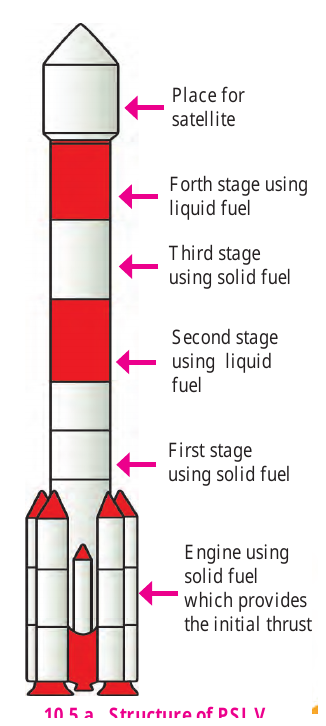
PSLV has multiple stages. The textbook figure shows first stage with solid fuel, second stage with liquid fuel, third stage with solid fuel and fourth stage with liquid fuel.
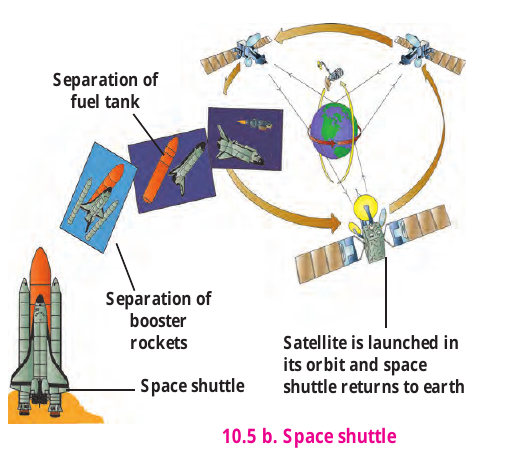
Launch vehicles are costly because they can generally be used only once. USA developed the space shuttle, which returns to Earth and can be reused in multiple launches.
Space Missions Away from Earth
Some space missions send spacecrafts to nearby objects in the solar system for close observation. Such missions provide information about the creation and evolution of the solar system.
For these missions, the spacecraft must escape Earth’s gravitational force. Therefore its initial velocity must be greater than the escape velocity of Earth.
Escape velocity
For Earth, escape velocity is approximately 11.18 km/s. Thus a spacecraft needs a minimum velocity of about 11.2 km/s to escape Earth’s gravitational force.
Escape Velocity – Board Answer
Escape velocity is the minimum velocity required by an object to escape from the gravitational influence of a planet.
For Earth
Using the textbook values:
Therefore, a spacecraft travelling away from Earth must have an initial velocity greater than the escape velocity to leave Earth’s gravitational influence.
Moon Missions
The Moon is the closest astronomical object to Earth, so the first space missions to solar-system objects were Moon missions.
- Soviet Union sent Luna series spacecrafts.
- Luna 2, launched in 1959, was the first such craft.
- Moon’s chemical composition, gravity, density and radiation were studied.
- Some spacecrafts landed and brought Moon-rock samples to Earth.
- USA conducted Moon missions from 1962 to 1972; some were manned.
- Neil Armstrong became the first human to step on the Moon in July 1969.
Chandrayaan-1
- ISRO launched Chandrayaan-1 in 2008.
- It was placed in orbit around the Moon.
- It sent useful information to Earth for about a year.
- The most important discovery was the presence of water on the Moon surface.
Mars Missions
Mars is the astronomical object nearest to Earth after the Moon. Mars missions are difficult and many missions have been unsuccessful.
Mangalyaan
- Made by ISRO using minimum expenses.
- Launched in November 2013.
- Placed into orbit around Mars in September 2014.
- Obtained useful information about the surface of Mars and its atmosphere.
Indian Space Explorers
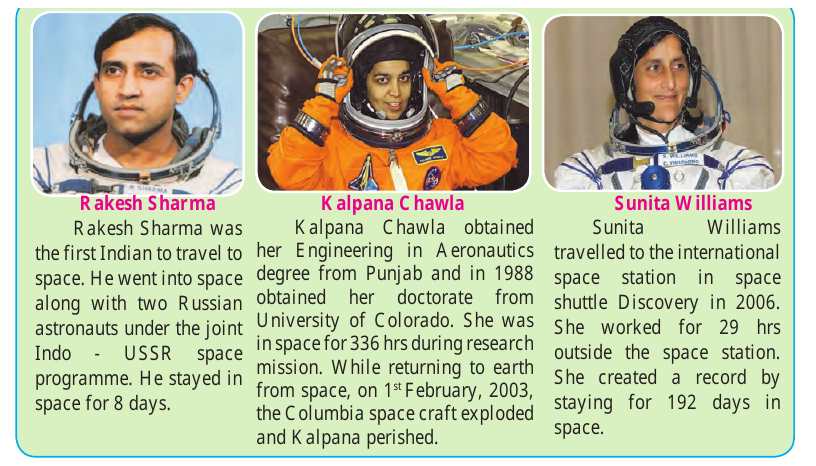
Rakesh Sharma
First Indian to travel to space. He went with two Russian astronauts under the joint Indo-USSR space programme and stayed in space for 8 days.
Kalpana Chawla
She obtained an Engineering in Aeronautics degree and later a doctorate. She spent 336 hours in space during a research mission. The Columbia spacecraft exploded while returning to Earth on 1 February 2003.
Sunita Williams
She travelled to the International Space Station in space shuttle Discovery in 2006. She worked outside the space station for 29 hours and created a record by staying 192 days in space.
Missions to Other Planets
Many missions have been executed to study other planets. Some spacecrafts orbited planets, some landed on planets and some passed near them for observation.
- Spacecrafts have been sent to observe asteroids and comets.
- Some missions collected dust and stones from asteroids and brought them back to Earth.
- Such missions provide useful information about the origin and evolution of the solar system.
India and Space Technology
Space research organisations
- Vikram Sarabhai Space Center – Thiruvananthapuram
- Satish Dhawan Space Research Center – Sriharikota
- Space Application Center – Ahmedabad
Satellite launch centres
- Thumba – Thiruvananthapuram
- Sriharikota
- Chandipur – Odisha
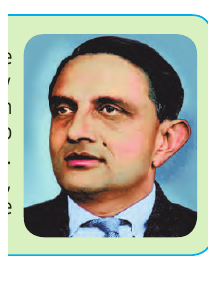
Vikram Sarabhai is considered the father of Indian space program. His efforts contributed to PRL, the Indian National Committee for Space Research, the Thumba launch centre, Aryabhatta and the establishment of ISRO.
Space Debris and its Management
Non-functional satellites, detached launcher parts and debris generated by collisions of satellites or other objects in space are called space debris.
Problems
- Debris can collide with artificial satellites.
- It can damage satellites and spacecrafts.
- The quantity of debris is increasing.
- It may make future spacecraft launches difficult.
Management
It is essential to manage space debris. Studies and experiments are being done to find solutions so that future satellites and spacecrafts remain safe.
India’s Major Space Technology Contributions
| Series / vehicle | Major contribution |
|---|---|
| PSLV | Important Indian launcher for satellites |
| GSLV | Important launcher for satellites |
| INSAT / GSAT | Telecommunication, television broadcasting and meteorological services |
| EDUSAT | Education field |
| IRS | Monitoring and management of natural resources and disaster management |
| IRNSS | Precise latitude and longitude information |
India has made remarkable progress in launch vehicles and satellite technology, contributing to national and social development.
Board Exam Quick Revision – Definitions
- Artificial satellite – manmade object revolving around Earth or another planet in a fixed orbit.
- Critical velocity – specific velocity required by a satellite to revolve in a specific orbit.
- Geostationary satellite – satellite appearing stationary with respect to Earth because its orbital period is about 24 hours and it revolves parallel to the equator.
- Satellite launch vehicle – vehicle used to place satellites in their specific orbits.
- Escape velocity – minimum velocity required to escape a planet’s gravitational influence.
- Space debris – non-functional satellites, launcher parts and collision debris revolving in space.
Important Values to Remember
| Point | Value |
|---|---|
| Sputnik | 1957 |
| Yuri Gagarin | 1961 |
| Neil Armstrong | 1969 |
| Rakesh Sharma | 1984 |
| Chandrayaan-1 | 2008 |
| Mangalyaan launch | 2013 |
| Mangalyaan Mars orbit | 2014 |
| LEO | 180–2000 km |
| MEO | 2000–35780 km |
| HEO | ≥35780 km |
| Earth escape velocity | ≈11.2 km/s |
Most Important Formulas
Use SI units consistently while solving numericals, and write the final answer with the correct unit.
Board Exam Important Questions
- What is an artificial satellite? How are satellites classified based on their functions?
- What is meant by the orbit of a satellite? On what basis are artificial satellite orbits classified?
- Why are geostationary satellites not useful for studies of polar regions?
- What is a satellite launch vehicle? Explain PSLV with a schematic diagram.
- Why is it beneficial to use launch vehicles made of more than one stage?
- Explain space missions away from Earth.
- What is escape velocity? Write its formula and value for Earth.
- Write a short note on Chandrayaan-1.
- Write a short note on Mangalyaan.
- What is space debris? Explain its harmful effects and the need for management.
Final Board Tips
Start with the definition or main statement. Then write the required points in logical order. Add the textbook figure, formula or reaction wherever the question asks for it.
- For derivations, write every force equation step-by-step.
- For numericals, use Given → Formula → Substitution → Calculation → Final Answer.
- For satellite questions, remember LEO, MEO, HEO and their height ranges.
- For India-related questions, remember PSLV, GSLV, INSAT, GSAT, IRS and IRNSS.
- For mission questions, remember the key years and achievements from the textbook.
Chapter 10 – One-Page Memory Map
- Artificial satellites → communication, weather, broadcast, navigation, military, Earth observation
- Orbits → LEO, MEO, HEO
- Critical velocity → √GMR+h
- Geostationary → about 35780 km, about 24 h, equatorial
- Launch vehicles → Newton’s third law, multistage design
- PSLV / GSLV → Indian launch vehicles
- Escape velocity → √2GMR ≈ 11.2 km/s for Earth
- Moon → Luna, Apollo, Chandrayaan-1
- Mars → Mangalyaan
- India → Vikram Sarabhai, ISRO, INSAT, GSAT, IRS, IRNSS
- Space debris → hazard and management
Final Textbook-Based Revision
Chapter 10 connects satellite technology, orbital motion, launch vehicles, escape velocity, planetary missions and India’s contribution to space research. Revise the definitions, orbit classifications, formulas, solved numericals, mission milestones and Indian satellite programmes before the board examination.